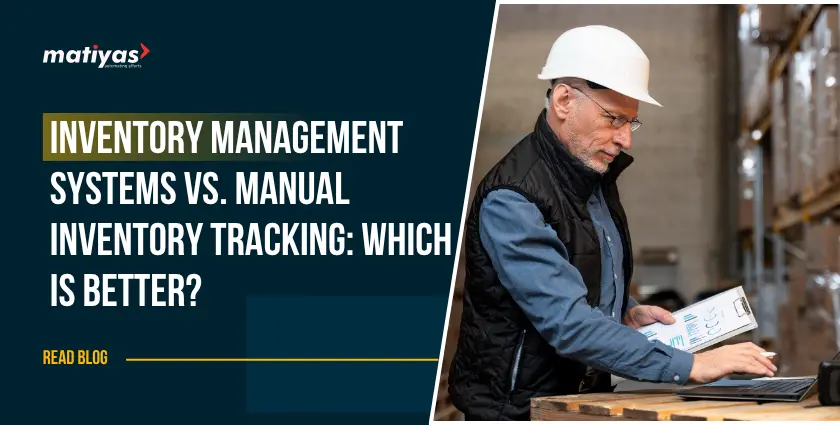
Managing inventory accurately is essential for businesses that buy, store, manufacture, or sell products. For years, many businesses have relied on spreadsheets, paper records, and manual stock counts to track inventory. While these methods may work for a small operation, they can become difficult to maintain as inventory levels, orders, employees, and warehouse locations increase.
This is where inventory management systems can make a significant difference. Instead of manually updating stock records, businesses can use inventory management software to automate stock tracking, monitor inventory levels, manage warehouse activities, and gain real-time visibility into their operations.
But does every business need an inventory management system? Or can manual inventory tracking still be a practical option?
This guide compares inventory management systems vs. manual inventory tracking to help businesses understand the differences and choose the right approach for their needs.
What Is Manual Inventory Tracking?
Manual inventory tracking is the process of recording and updating inventory information without dedicated inventory management software. Businesses commonly use Excel spreadsheets, paper registers, stock sheets, or manually maintained databases to record incoming and outgoing inventory. To understand the broader process and importance of inventory management, see our guide on what is inventory management.
For example, when a business receives 100 units of a product, an employee may manually update the spreadsheet. When 20 units are sold, the employee needs to subtract those units from the available stock. Physical stock counts may then be performed periodically to verify whether the recorded quantity matches the actual inventory.
Manual tracking can work for businesses with:
- A small number of products
- Low order volumes
- A single warehouse or location
- Limited inventory transactions
- Few employees managing stock
However, the process becomes more challenging as the business grows. More transactions mean more data entry, more opportunities for errors, and more time spent maintaining records.
The biggest issue is that manual inventory tracking usually depends heavily on employees remembering to update records correctly and on time.
What Are Inventory Management Systems?
Inventory management systems are software solutions designed to help businesses track, manage, and control inventory throughout its lifecycle.
Instead of relying entirely on spreadsheets or manual records, an inventory management system centralizes inventory data and automates many routine processes. Depending on the solution, businesses can track stock levels, purchases, sales, transfers, returns, warehouses, and other inventory activities from a single platform.
Modern inventory management software can also provide features such as:
- Real-time stock tracking
- Automated stock updates
- Purchase and sales integration
- Barcode scanning
- Low-stock alerts
- Inventory transfers
- Warehouse management
- Stock movement tracking
- Inventory reports and dashboards
- Multi-location inventory management
- User access controls
An inventory monitoring system can give managers a clearer picture of what is currently available, what has been sold, what has been received, and what needs to be reordered.
When connected with other business processes, inventory software can also reduce the need for employees to maintain separate records across multiple systems.
Inventory Management Systems vs. Manual Tracking: Key Differences
The main difference between manual tracking and inventory management systems is how inventory data is captured, updated, and used.
| Factor | Manual Inventory Tracking | Inventory Management System |
|---|
| Data Entry | Mostly manual | Automated or streamlined |
| Stock Visibility | Often delayed | Real-time or near real-time |
| Accuracy | Higher risk of human errors | Better consistency |
| Stock Counting | Time-consuming | Faster with automation |
| Reporting | Manually prepared | Automated reports and dashboards |
| Scalability | Limited | Designed to scale |
| Multi-location Tracking | Difficult | Centralized management |
| Stock Alerts | Usually manual | Automated alerts |
| Warehouse Operations | Limited integration | Can integrate with warehouse processes |
| Decision-making | Based on manually updated data | Based on current inventory information |
1. Data Entry and Automation
Manual inventory management requires employees to enter and update data themselves. Every purchase, sale, return, transfer, or adjustment may require a separate update.
Inventory management software reduces this repetitive work by automatically updating inventory when transactions occur.
For example, when an order is processed, the corresponding stock quantity can be updated within the system. This reduces the number of manual steps employees need to complete.
2. Inventory Accuracy
Inventory accuracy is one of the biggest challenges with manual tracking.
A simple data-entry mistake can result in incorrect stock information. If an employee forgets to record a sale or enters the wrong quantity, the spreadsheet may show more inventory than is actually available.
With an automated stock management system, inventory movements can be recorded systematically. This makes it easier to maintain accurate stock records and identify discrepancies.
3. Real-Time Inventory Visibility
With manual tracking, inventory information may not always reflect the current stock position.
For example, if a warehouse employee updates a spreadsheet at the end of the day, the sales team may not know the exact stock available during the day.
An inventory management system can provide centralized visibility into stock levels. Depending on the system and integrations, employees can see inventory changes as transactions are processed.
This helps businesses answer important questions quickly:
- How much stock is available?
- Which products are running low?
- Which items are overstocked?
- What inventory has recently arrived?
- Which warehouse has available stock?
- Which products are moving quickly?
Better visibility can help businesses make faster purchasing, sales, and operational decisions.
How Inventory Management Systems Reduce Stock Errors
Inventory errors can affect almost every part of a business.
If stock records are inaccurate, businesses may purchase products they already have, fail to reorder products that are running low, or accept orders for items that are unavailable.
Manual inventory tracking increases the risk of:
- Duplicate data entry
- Incorrect quantities
- Missed transactions
- Lost records
- Outdated spreadsheets
- Calculation mistakes
- Inconsistent stock information
Inventory management systems can reduce these issues by centralizing inventory information and automating repetitive processes. Learn more about the benefits of inventory management software and how automation can improve inventory control.
For businesses handling hundreds or thousands of products, even a small improvement in inventory accuracy can save significant time and reduce operational problems.
Real-Time Stock Visibility and Inventory Monitoring
A major advantage of an inventory monitoring system is the ability to track stock movement more efficiently.
Instead of waiting for a weekly or monthly stock count, businesses can monitor inventory throughout the day. Managers can use dashboards, reports, and alerts to identify changes in inventory levels.
For example, a business can configure low-stock notifications for products that need to be reordered. This helps purchasing teams act before inventory reaches a critical level.
Real-time visibility can also help businesses identify slow-moving products. Rather than allowing excess stock to remain unnoticed, managers can review inventory reports and make better purchasing decisions.
This is particularly valuable for businesses where inventory represents a significant portion of operating capital.
Warehouse Management and Operational Efficiency
Inventory management is closely connected to warehouse operations. Businesses need to know not only how much stock they have, but also where that stock is located and how it moves through the warehouse.
A warehouse management system can help manage activities such as receiving, storing, picking, packing, and dispatching inventory. When warehouse processes are connected with inventory management, businesses can gain better visibility across their operations.
For example, when products are received, their quantities and locations can be recorded. When items are picked for an order, the available inventory can be adjusted accordingly.
This reduces the dependency on separate spreadsheets and manual communication between warehouse, sales, purchasing, and management teams.
Cloud-Based Inventory Management: A Smarter Alternative
Traditional inventory systems may require software and data to be maintained on local computers or servers. Cloud based inventory management systems provide another approach by storing business data in a cloud environment.
Cloud inventory management software allows authorized users to access inventory information from different locations and devices, making it easier for distributed teams to manage stock.
Some key advantages include:
- Remote access to inventory information
- Centralized data
- Easier collaboration
- Automatic system updates
- Improved accessibility
- Easier scalability
- Reduced dependence on local files
Cloud-based systems can be especially useful for businesses with multiple warehouses, branches, or teams working from different locations.
However, businesses should evaluate security, integrations, user permissions, data backup, and vendor support before selecting a cloud inventory solution.
Which Is Better for Small Businesses?
Not every small business needs a sophisticated inventory system from day one.
A business with a handful of products, limited transactions, and one location may be able to manage inventory using a spreadsheet. However, as operations expand, manual processes can quickly become a bottleneck.
Inventory management software for small business can become valuable when:
- The number of products is increasing
- Orders are becoming more frequent
- Multiple employees handle inventory
- Stock discrepancies are common
- Manual reporting takes too much time
- The business operates from multiple locations
- Purchasing decisions require accurate stock information
An inventory management system for small business does not necessarily need to be complex. Businesses should look for a solution that matches their current requirements while providing enough flexibility to support future growth.
The goal should not be to automate everything simply because technology is available. The goal is to eliminate unnecessary manual work and improve inventory visibility where it matters most.
When Should a Business Switch From Manual Tracking?
There is no single point at which every business must adopt an inventory management system. However, certain signs indicate that manual tracking may no longer be sufficient.
1. Inventory discrepancies happen frequently
If recorded stock regularly differs from physical stock, the current process may need improvement.
2. Employees spend too much time updating spreadsheets
If staff members spend hours maintaining inventory records instead of focusing on productive activities, automation may provide significant benefits.
3. Stockouts are becoming common
Frequent stockouts may indicate that purchasing decisions are being made without accurate or timely inventory information.
4. Overstocking is increasing
Excess inventory ties up working capital and can increase storage costs. Better inventory visibility can help businesses make more informed purchasing decisions.
5. You have multiple warehouses or locations
Managing inventory across multiple locations with separate spreadsheets can become complicated very quickly.
6. Management needs faster reports
If managers have to wait for employees to prepare inventory reports manually, the business may benefit from centralized dashboards and automated reporting.
7. The business is growing
Growth often means more products, customers, suppliers, employees, and transactions. A process that worked for a small business may not work efficiently at a larger scale.
How to Choose the Right Inventory Management System
If your business has decided to move beyond manual tracking, selecting the right system is important. Before making a decision, it is worth reviewing a practical guide to choosing the right inventory management system based on your business requirements.
Start by identifying your actual inventory requirements rather than choosing software based only on the number of features it offers.
Consider the following factors:
Business size and inventory volume
Choose software that can handle your current number of products and expected future growth.
Warehouse and location requirements
If you operate multiple warehouses, make sure the system supports centralized stock visibility and inventory transfers.
Sales and purchasing integration
Your inventory system should ideally connect inventory movements with sales orders, purchases, and other relevant business processes.
Reporting and analytics
Look for useful reports that help you understand stock levels, inventory movement, slow-moving products, and purchasing requirements.
Automation
Consider features such as automatic stock updates, alerts, barcode scanning, and automated workflows.
Cloud accessibility
If your employees need to access inventory data from different locations, cloud-based inventory management may be worth considering.
Scalability
The system should be able to grow with your business instead of forcing you to replace it when your inventory operations become more complex.
Ease of use
Even a feature-rich system will not deliver value if employees find it difficult to use. User experience and training should therefore be part of the evaluation process. If you are comparing different solutions, our guide to the best inventory management software can help you evaluate the options more effectively.
Why Choose an Inventory Management System Over Manual Tracking?
Manual inventory tracking can be suitable for businesses with simple operations, limited products, and low transaction volumes. It is inexpensive to start and does not require specialized software.
However, as a business grows, spreadsheets and manual records can become difficult to maintain. Data-entry errors, delayed updates, stock discrepancies, and time-consuming reporting can affect operational efficiency and customer service.
Inventory management systems provide a more scalable approach by centralizing inventory data, automating routine processes, improving stock visibility, and supporting better decision-making.
The right choice ultimately depends on your business requirements. If manual inventory tracking is already taking too much time or causing frequent errors, it may be time to consider an automated inventory management solution.
Ready to Move Beyond Manual Inventory Tracking?
Matiyas Solutions helps businesses streamline inventory and broader business operations with ERP and inventory management solutions designed around their specific requirements. From centralized stock management and real-time inventory visibility to purchasing, sales, warehouse operations, and reporting, an integrated system can reduce manual work and improve operational control.
Ready to improve your inventory management? Contact Matiyas Solutions to discuss your business requirements and find the right ERP and inventory management solution for your needs.
Frequently Asked Questions






 "I am quite happy with the ERP solution provided by Matiyas. Before we implemented their system, our organization was struggling with inefficient processes and fragmented data. Their customized ERP solution not only streamlined our workflows but also provided real-time insights into our operations. The customer support from Matiya's Team has been exceptional throughout the journey."
 "Matiyas offered us a functionally strong and automated solution to address the end-to-end needs of our business operation. This solutions will be able to scale and grow our business and it will surely reduce manual interventions."
 "I wanted to thank you Matiyas team to set-up the ERP system based on our business process. The assistance was invaluable in helping my company get as we requested. We sincerely appreciate your efforts and thanks again Matiyas team to provide us a best solution with the erp system."

 "The implementation of the Matiyas ERP solution has revolutionized our workflow. The automation of previously manual processes has not only saved us time but also significantly reduced errors. It’s like having an extra set of hands on our team, streamlining operations and boosting productivity"



 "Our company is very new to ERP, we tried to implement ERP by ourselves, however along the way we found struggles as we are very new. We are lucky HasanAli from Matiyas helped us in many ways, from a simple question to very complex developments and deployments. Rates are reasonable too! We are happy that Matiyas is there to help us."
 "The folks at Matiyas Software are the best. They're skilled, work quickly and professionally, and were able to tailor ERP to our exact specifications. Would use them again."
 "Very knowledgeable and prompt and professional. I highly recommend Matiyas for any ERP customizations."