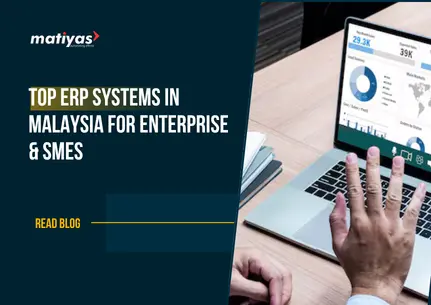
Choosing the top ERP system in Malaysia depends on more than software features. Malaysian businesses need to consider their industry, business size, required modules, implementation approach, budget, scalability, and local compliance requirements.
The market includes ERP platforms designed for SMEs, mid-sized businesses, manufacturers, distributors, retailers, and larger enterprises. Some systems focus on flexibility and customization, while others emphasize industry functionality, financial management, supply chain operations, or integration with wider technology ecosystems.
This guide compares leading ERP systems in Malaysia, explains what businesses should look for, discusses suitable options for SMEs and different industries, and covers Malaysia e-Invoicing, ERP implementation costs, and practical steps for selecting an ERP system.
What Is an ERP System?
An Enterprise Resource Planning (ERP) system is a centralized software platform that connects important business processes and data in one system. Instead of maintaining separate applications or spreadsheets for finance, inventory, sales, purchasing, manufacturing, and HR, businesses can manage these functions through integrated ERP software.
Common ERP modules include:
- Finance and accounting
- Inventory management
- Sales
- Purchasing
- Manufacturing
- Human resources and payroll
- Customer relationship management
- Supply chain management
- Reporting and analytics
For Malaysian businesses, an ERP system can provide a shared operational view across departments while supporting business processes that may otherwise depend on disconnected tools.
Why Malaysian Businesses Need ERP Software
Businesses looking for ERP software in Malaysia often need to manage multiple functions while maintaining accurate and timely information.
A centralized ERP system can help businesses improve visibility across inventory, purchasing, sales, finance, production, and other operations. This becomes increasingly important when companies operate across multiple locations, warehouses, branches, or business units.
Manufacturers may need production planning, bills of materials, material tracking, and inventory control. Retailers may need POS, purchasing, customer information, and stock visibility. Distributors may prioritize warehouse, order, and supply-chain management.
Financial processes are another important consideration. Malaysian businesses should evaluate how an ERP handles accounting, taxation-related workflows, reporting, and e-Invoicing requirements.
For businesses exploring ERP solutions specifically for the Malaysian market, see ERP software in Malaysia.
What to Look for in a Top ERP System in Malaysia
Before comparing ERP vendors, businesses should establish the criteria they will use to evaluate each system.
A top ERP system in Malaysia should be assessed against practical business requirements rather than simply its popularity.
Important considerations include:
Malaysia Localization
Check whether the ERP can support the company’s Malaysian financial and operational requirements and whether the implementation partner can configure the system appropriately.
e-Invoicing Support
Businesses should evaluate whether the ERP can support their e-Invoicing workflows and integration requirements.
Accounting and Finance
The system should provide the financial functionality required by the business, including accounting, reporting, receivables, payables, and other relevant processes.
Inventory and Manufacturing
Manufacturers, distributors, and retailers should assess inventory visibility, warehouse management, production planning, bills of materials, and related capabilities.
Integration
Consider whether the ERP can integrate with existing applications, payment systems, e-commerce platforms, CRM systems, payroll systems, or other business tools.
Customization and Scalability
The system should accommodate current requirements while allowing the business to add users, modules, locations, workflows, and integrations as it grows.
Implementation and Support
ERP success depends on more than software. Implementation, migration, training, customization, technical support, and ongoing maintenance should also be evaluated.
Total Cost of Ownership
Compare the complete cost rather than looking only at the initial license or subscription price.
Top ERP Systems in Malaysia
There is no single ERP platform that is suitable for every Malaysian organization. The following systems represent different approaches to ERP and can be evaluated according to business size, industry, functionality, deployment preferences, and implementation requirements.
1. ERPNext
ERPNext is an open-source ERP platform covering accounting, CRM, sales, purchasing, inventory, manufacturing, HR, projects, assets, and other business processes. Its manufacturing capabilities include multi-level bills of materials, production planning, job cards, and inventory management.
ERPNext can be considered by SMEs and mid-market organizations that need an integrated ERP platform with customization possibilities. Its open-source architecture can also be relevant for businesses that want greater control over workflows and system configuration.
For businesses evaluating implementation, customization, integration, training, and support, an experienced ERPNext partner can be part of the evaluation process.
2. SAP Business One / SAP
SAP provides ERP solutions covering different organizational requirements. SAP Business One is commonly associated with growing businesses, while SAP’s broader portfolio serves larger and more complex organizations.
Businesses evaluating SAP should consider the required modules, deployment model, implementation scope, integration requirements, industry needs, and long-term ownership costs.
SAP can be particularly relevant where organizations require structured financial, manufacturing, supply-chain, and enterprise processes.
3. Microsoft Dynamics 365
Microsoft Dynamics 365 combines business applications covering areas such as finance, supply chain, sales, service, and operations. Microsoft describes Dynamics 365 as a collection of applications that can be used individually or together to connect business processes and data.
Its supply-chain capabilities include planning, procurement, shop-floor management, order management, warehouse management, and asset management.
It can therefore be relevant for growing and larger organizations already operating within the Microsoft ecosystem.
4. Oracle NetSuite
Oracle NetSuite is a cloud-based business management platform covering ERP and financial management alongside CRM and e-commerce capabilities. Oracle’s documentation also covers accounting, inventory, order management, purchasing, projects, and employee management.
NetSuite can be considered by companies looking for a cloud ERP platform and organizations managing multiple business processes or entities as they scale.
5. Odoo
Odoo uses a modular approach with applications covering accounting, invoicing, CRM, sales, inventory, manufacturing, e-commerce, POS, HR, and other business functions.
Its manufacturing functionality includes bills of materials, manufacturing orders, work centers, production planning, quality processes, traceability, and production reporting.
This makes Odoo an option for businesses that prefer a modular approach and want to expand their ERP functionality over time.
6. Infor CloudSuite
Infor CloudSuite provides industry-focused ERP capabilities and is associated with sectors where manufacturing, supply chain, and specialized operational workflows are important.
Businesses considering Infor should evaluate the specific CloudSuite edition relevant to their industry, implementation requirements, integrations, and localization needs.
7. Acumatica
Acumatica is a cloud ERP platform designed for growing organizations. Its areas of application can include distribution, manufacturing, finance, and other business processes.
It may be considered by organizations looking for cloud deployment and flexibility as their operational requirements develop.
8. Epicor
Epicor provides ERP solutions with a strong focus on industries such as manufacturing and distribution.
Businesses evaluating Epicor should consider production processes, supply-chain requirements, inventory management, industry functionality, integrations, and implementation requirements.
9. SYSPRO
SYSPRO is an ERP platform associated particularly with manufacturing and distribution businesses.
Its evaluation should focus on production management, inventory, distribution processes, financial requirements, integrations, and the organization’s specific operational workflows.
10. Sage
Sage provides business software with a strong focus on accounting and financial management, alongside solutions for growing organizations.
Businesses considering Sage should assess the specific product edition, required ERP functionality, integrations, localization requirements, and scalability before making a decision.
ERP Systems in Malaysia: Comparison
The following comparison provides a high-level view of how the platforms can fit different business requirements. It should be treated as a starting point rather than a universal ranking.
| ERP | Best For | Business Size | Deployment | Key Strength |
|---|
| ERPNext | Flexible business management | SME–Mid-market | Cloud/On-premise | Customization |
| SAP Business One | Growing businesses | SME–Mid-market | Cloud/On-premise | Business management |
| Dynamics 365 | Integrated business operations | Mid-market–Enterprise | Cloud | Microsoft ecosystem |
| NetSuite | Scaling businesses | Mid-market–Enterprise | Cloud | Financial management |
| Odoo | Modular business management | SME–Mid-market | Cloud/On-premise | Modular architecture |
| Infor | Industry-specific operations | Mid-market–Enterprise | Cloud | Industry capabilities |
| Acumatica | Growing companies | SME–Mid-market | Cloud | Flexibility |
| Epicor | Manufacturing/distribution | Mid-market | Cloud | Industry functionality |
The most suitable system depends on the organization’s actual requirements, implementation scope, budget, and preferred operating model.
Best ERP Systems for Malaysian SMEs
For SMEs searching for the best ERP system for SMEs in Malaysia, software selection should focus on practical business requirements rather than simply choosing the platform with the largest feature list.
Important factors include:
- Initial and ongoing cost
- Implementation complexity
- Ease of use
- Required modules
- Customization
- Integrations
- Scalability
- Local compliance requirements
- Vendor and implementation support
An SME may not need every enterprise-level feature. Instead, it should identify the processes that create the most operational problems and select an ERP that can address those processes without creating unnecessary complexity.
Platforms such as ERPNext, Odoo, SAP Business One, and Acumatica can be evaluated depending on the company’s size, industry, budget, deployment preference, and functional requirements.
Businesses interested specifically in ERPNext can explore ERPNext partner and assess whether the platform matches their requirements.
Best ERP Systems by Industry in Malaysia
The right ERP system can vary significantly by industry because each sector has different workflows and data requirements.
| Industry | Important ERP Requirements |
|---|
| Manufacturing | Production, BOM, planning, inventory |
| Retail | POS, inventory, purchasing, customer data |
| Distribution | Warehouse, inventory, order management |
| Trading | Purchasing, sales, finance, inventory |
| Logistics | Warehousing, fleet, delivery, tracking |
| Healthcare | Finance, inventory, operations, compliance |
For example, a manufacturing business may prioritize production planning and material management, while a retail organization may place greater importance on POS and real-time inventory.
A logistics company may require warehouse, delivery, fleet, and tracking capabilities. Therefore, industry fit should be part of the ERP evaluation process.
ERP Features Malaysian Businesses Should Consider
When comparing ERP software in Malaysia, businesses should look beyond basic accounting and inventory functions.
Important capabilities can include:
- Finance and accounting
- Inventory management
- Procurement
- Sales management
- Manufacturing
- CRM
- HR and payroll
- Reporting and analytics
- Workflow automation
- API and third-party integrations
- Multi-company management
- Multi-currency support
- Localization
The importance of each feature depends on the business model. A manufacturer may require detailed production and material planning, while a distributor may prioritize warehouse and order management.
Multi-company and multi-currency capabilities can also become important for organizations expanding into additional markets.
Malaysia e-Invoicing and ERP: What Businesses Need to Know
Malaysia’s e-Invoicing requirements make financial-system readiness an important part of ERP evaluation.
According to the Inland Revenue Board of Malaysia, the e-Invoice implementation timeline is phased according to annual turnover or revenue. The official timeline currently lists implementation dates ranging from August 1, 2024 for taxpayers with annual turnover or revenue above RM100 million to January 1, 2026 for taxpayers with annual turnover or revenue up to RM5 million. The IRBM page also states that taxpayers with annual turnover or revenue below RM3 million are exempt. The timeline was updated on August 30, 2026.
Because regulatory requirements can change, businesses should verify the latest requirements directly with the Malaysian tax authority before finalizing their ERP implementation.
An ERP can help centralize customer, sales, accounting, and invoice data, making it easier to build structured invoicing workflows and connect financial processes with e-Invoicing requirements.
When evaluating an ERP system for Malaysia e-Invoicing, businesses should examine the available integration method, data flow, invoice processes, validation requirements, implementation responsibilities, and ongoing support.
For Malaysia-focused ERP requirements, businesses can also explore ERP solutions in Malaysia.
How Much Does ERP Software Cost in Malaysia?
There is no single price for ERP software in Malaysia because the total investment depends on the organization’s requirements.
Factors that can affect ERP software cost in Malaysia include:
- Number of users
- Required modules
- Cloud or on-premise deployment
- Implementation services
- Customization
- Data migration
- Third-party integrations
- Training
- Technical support
- Ongoing maintenance
A small business implementing a limited number of modules can have a very different cost structure from a manufacturer implementing finance, inventory, procurement, production, quality, warehouse management, integrations, and multiple locations.
Therefore, businesses should compare the total cost of ownership rather than selecting an ERP based only on license or subscription pricing.
How to Choose the Right ERP System in Malaysia
Choosing an ERP system should start with business requirements rather than vendor names.
A practical evaluation process is:
1. Define Business Requirements
Document current processes, operational problems, reporting requirements, and future business goals.
2. Identify Required Modules
Determine which modules are essential at launch and which can be introduced later.
3. Consider Malaysia Compliance
Review accounting, taxation, e-Invoicing, and other applicable Malaysian requirements.
4. Compare Implementation Requirements
Understand the expected timeline, migration process, configuration, customization, and training requirements.
5. Evaluate Customization and Integrations
Check whether the ERP can connect with existing business applications and support required workflows.
6. Calculate Total Cost of Ownership
Include software, implementation, customization, migration, training, integrations, support, and future expansion.
7. Assess Vendor Support
Review implementation expertise, technical support, documentation, response processes, and long-term service availability.
8. Request a Demo
Use a demo to test actual business workflows rather than reviewing features only in a product brochure.
Conclusion
The top ERP system in Malaysia is not necessarily the same for every organization. A manufacturing company may prioritize production and inventory management, while a retailer may need POS and stock visibility. A growing enterprise may place greater emphasis on financial consolidation, supply-chain management, integrations, and scalability.
Before selecting an ERP, Malaysian businesses should compare business requirements, industry functionality, features, compliance needs, implementation complexity, total cost, and support.
The objective should be to select an ERP system that fits the company’s current operations while providing enough flexibility to support future growth.
For businesses looking for ERP implementation and related services in Malaysia, explore ERP services in Malaysia.
FAQs About ERP Systems in Malaysia



 "I am quite happy with the ERP solution provided by Matiyas. Before we implemented their system, our organization was struggling with inefficient processes and fragmented data. Their customized ERP solution not only streamlined our workflows but also provided real-time insights into our operations. The customer support from Matiya's Team has been exceptional throughout the journey."
 "Matiyas offered us a functionally strong and automated solution to address the end-to-end needs of our business operation. This solutions will be able to scale and grow our business and it will surely reduce manual interventions."
 "I wanted to thank you Matiyas team to set-up the ERP system based on our business process. The assistance was invaluable in helping my company get as we requested. We sincerely appreciate your efforts and thanks again Matiyas team to provide us a best solution with the erp system."

 "The implementation of the Matiyas ERP solution has revolutionized our workflow. The automation of previously manual processes has not only saved us time but also significantly reduced errors. It’s like having an extra set of hands on our team, streamlining operations and boosting productivity"



 "Our company is very new to ERP, we tried to implement ERP by ourselves, however along the way we found struggles as we are very new. We are lucky HasanAli from Matiyas helped us in many ways, from a simple question to very complex developments and deployments. Rates are reasonable too! We are happy that Matiyas is there to help us."
 "The folks at Matiyas Software are the best. They're skilled, work quickly and professionally, and were able to tailor ERP to our exact specifications. Would use them again."
 "Very knowledgeable and prompt and professional. I highly recommend Matiyas for any ERP customizations."