
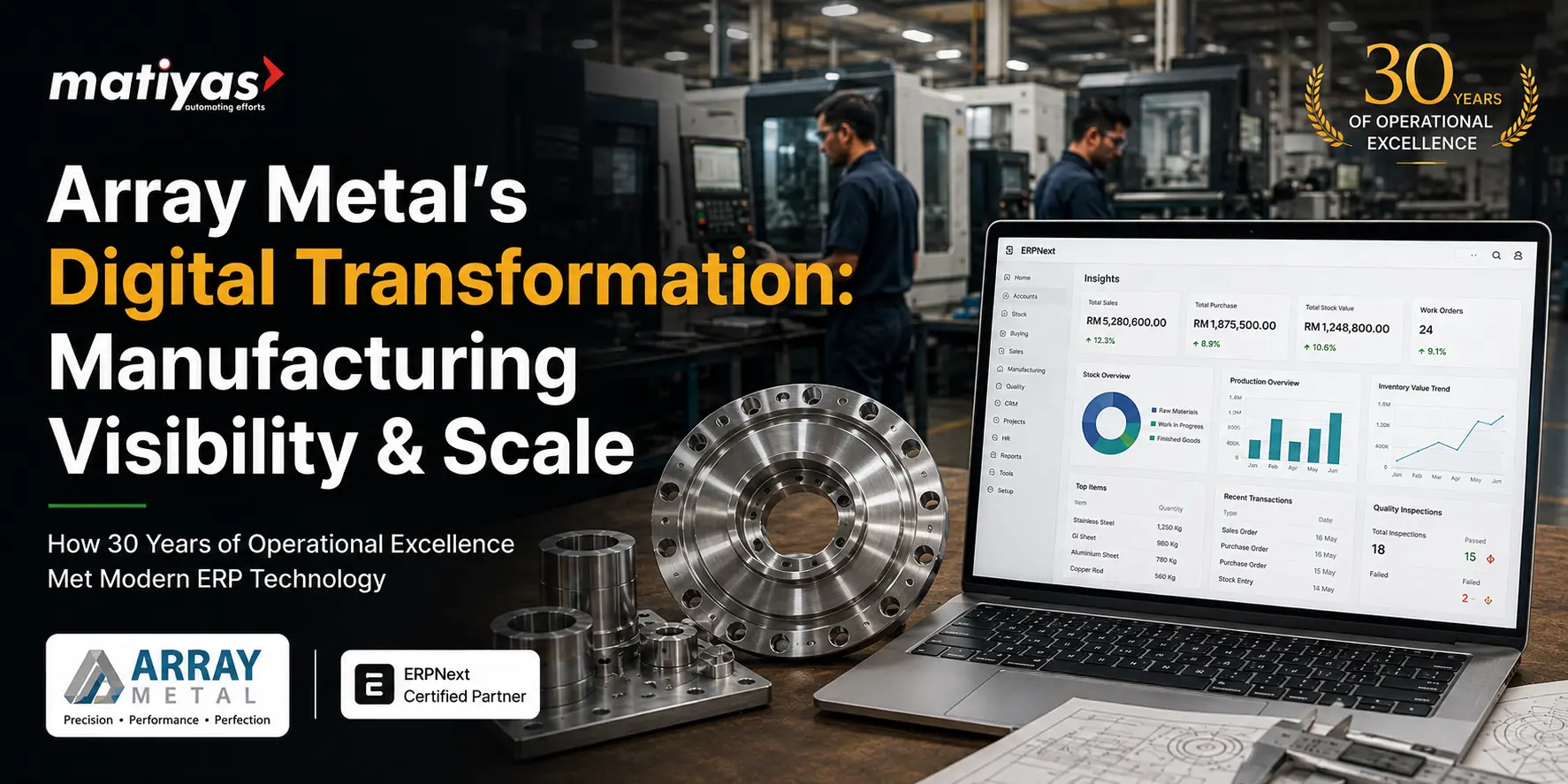
Array Metal (M) SDN. BERHAD, a leading mid-sized manufacturing company with 100+ employees across multiple locations in Malaysia, faced a critical challenge: disconnected business processes spread across accounting, inventory, procurement, sales, production, and HR operations. Operating primarily on manual spreadsheets and disparate systems, Array Metal lacked real-time visibility into operations and struggled with compliance, reporting, and scalability.
We implemented comprehensive ERPNext implementation services tailored to Array Metal’s manufacturing requirements, delivering a robust manufacturing ERP software solution that unified seven core business modules into a single, integrated ecosystem. The transformation delivered Array Metal instant operational visibility, automated workflows, and strategic decision-making capabilities, enabling the company to scale efficiently while maintaining compliance across all operations.
The Challenge: Operating in Silos
Business Complexity Without Integration
Array Metal operated a complex, multi-faceted manufacturing business with challenging operational requirements:
• Multiple Warehouses & Locations – Managing inventory across raw materials, work-in-progress, and finished goods across multiple storage locations.
• Complex Product Portfolio – Variant-based products with different thicknesses, grades, and specifications requiring sophisticated tracking.
• Two-Shift Production – Operating continuous production cycles requiring real-time job tracking and resource management.
• Diverse Customer Base – Managing 30/60/90-day credit terms, cash-on-delivery orders, and international multi-currency transactions.
• Compliance Requirements – Operating across multiple regulatory requirements for accounting, taxation, and HR (Malaysian statutory compliance).
Critical Pain Points
1. Financial Management
• Manual bank reconciliation taking hours each month
• Disconnected accounting records and inventory movements
• Lack of real-time P&L and cash flow visibility
• Multi-currency transactions managed through spreadsheets
• Fixed asset depreciation tracked manually
• Invoices created manually without e-invoice compliance mandate
2. Inventory & Stock
• No visibility into stock levels across warehouses
• Manual stock counting and reconciliation
• Inconsistent inventory valuation methods
• Weight-based tracking for materials (metal coils) done outside the system
• Frequent inter-warehouse transfers without systematic tracking
3. Procurement
• Purchase orders created in disconnected formats
• No systematic quality inspection before stock acceptance
• Supplier invoices matched manually to purchase orders
• Landed costs (freight, customs) not accurately allocated to items
• Subcontracting operations difficult to track
4. Sales Operations
• Quotations and orders created manually
• No real-time visibility into customer credit status or outstanding dues
• Advance payments from customers not systematically linked to orders
• Delivery tracking fragmented between in-house and third-party logistics
• Sales performance and customer analytics unavailable
5. Manufacturing & Production
• Bill of Materials (BOMs) partially maintained; most products not systematized
• Production planning done manually based on delivery dates and manpower availability
• 135+ machines and workstations with no capacity tracking
• Work orders and job cards managed outside the system
• No real-time production progress visibility
• Quality inspections done ad-hoc without templates or systematic tracking
• Scrap/wastage generation not tracked for costing or sales
6. Human Resources & Payroll
• Employee data scattered across multiple documents
• Manual attendance tracking prone to errors
• Leave management processed through spreadsheets
• Payroll calculated manually each month without automated compliance checks
• No integration between attendance, leave, and payroll
• Malaysian statutory compliance (EPF, SOCSO, HRDF, EIS) calculations done externally
7. Cross-Module Issues
• No single source of truth for business data
• Decision-making based on outdated or incomplete information
• Compliance and audit trails weak or non-existent
• Reporting took weeks to compile manually
• No scalability; adding users or locations required process redesign
The Solution: Comprehensive ERPNext Implementation for Array Metal
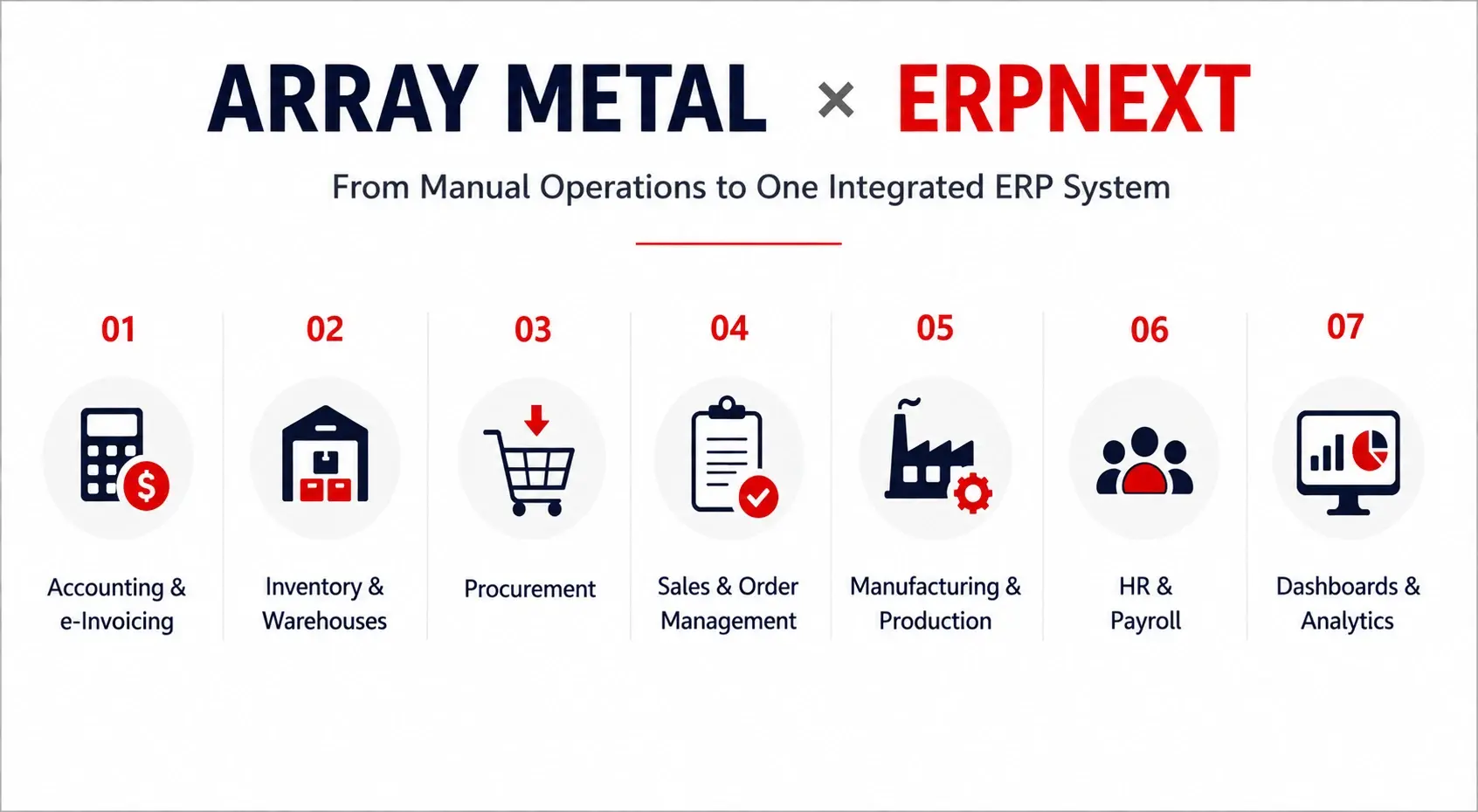
We implemented a complete ERPNext ERP ecosystem for Array Metal comprising seven integrated modules, custom workflows, and advanced reporting capabilities. Here’s how each area was transformed:
1. Accounting & Financial Management
Challenge: Disconnected financial records with no real-time visibility and manual invoice compliance management.
Solution Delivered:
• Malaysia e-Invoice Integration: Full compliance with Malaysia’s e-invoice mandate as per Inland Revenue Board (IRB) requirements. The system automatically generates, validates, and submits invoices in the required XML format to the IRB e-Invoice Portal. Features include:
- • Automatic invoice numbering with IRB compliance
• Real-time validation of invoice data before submission
• Batch submission capability for high-volume invoicing
• Audit trail for all submitted and rejected invoices
• Automatic status tracking and error handling
• Integration with customer data for recipient validation
• Support for various invoice types (standard, credit note, debit note)
• Exemption handling for special invoice categories
• Complete archival and retrieval of submitted e-invoices
• Perpetual Inventory Accounting: Every sale or purchase automatically updates stock, COGS (Cost of Goods Sold), and general ledger entries in real-time, ensuring the accounting and inventory ledgers are always synchronized
• Multi-Currency Support: MYR base currency with USD, AUD, and SGD enabled for international transactions, with automatic exchange rate handling
• Automated Bank Reconciliation: Manual bank matching transformed into an automated process, reducing monthly reconciliation time from hours to minutes
• Payment Entry System: All customer receipts and supplier payments recorded through a unified interface supporting multiple payment modes and bank account mapping
• Financial Reporting: Automated generation of:
- • Profit and Loss Statements
• Balance Sheets
• Accounts Receivable and Payable Aging reports
• General Ledger and Trial Balance
• Cash flow analysis
• Fixed Asset Management: Depreciation automated at a flat rate of 20% per year with asset sales and scrapping tracked systematically
• Post-Dated Cheque Tracking: System configured to track and manage post-dated cheques for both receivables and payables
Impact: From weeks of manual compilation to instant financial visibility. Real-time cash flow tracking enables better working capital management.
2. Inventory & Stock Management
Challenge: Manual stock tracking across three warehouses with no real-time valuation.
Solution Delivered:
• Multi-Warehouse Architecture: Structured warehouse hierarchy including Raw Material, Work-in-Progress, and Finished Goods warehouses with inter-warehouse transfer automation
• Inventory Valuation (FIFO Method): Automatic cost calculation based on FIFO method ensuring accurate stock valuation; every receipt and delivery automatically updates stock cost
• UOM Conversions: Sophisticated multi-unit handling:
- • Purchase in kilograms (KG)
• Storage and manufacturing in sheets/coils
• Sales in pieces (PCS)
• Automatic conversion factors ensure consistent tracking across all operations
• Batch & Serial Number Tracking: Enhanced traceability for controlled materials and specific coils, enabling full product history from raw material to finished goods
• Automated Reorder System: Configurable reorder levels and quantities trigger automatic material requests when stock drops below thresholds
• Weight-Based & Partial Delivery Handling: Accommodates metal coil receipts and partial deliveries with automatic quantity and valuation updates
• Quality Inspection Integration: Mandatory inspection templates before stock acceptance with results automatically linked to purchases
• Physical Stock Audits: Simplified reconciliation through systematic stock verification with batch or warehouse-wise audit capability
• Real-Time Stock Reports:
- • Stock Balance Report by warehouse
• Stock Ledger with complete transaction history
• Stock Aging analysis
• Batch-wise balance history
• Serial number ledger reports
Impact: Real-time visibility into inventory across all locations. 100% stock accuracy eliminates costly discrepancies. Automated reordering prevents stockouts while minimizing excess inventory.
3. Procurement (Buying Module)
Challenge: Fragmented purchasing process with quality and cost tracking gaps.
Solution Delivered:
• Standardized Purchase Workflow:
• Material Request → RFQ → Supplier Quotation → Purchase Order → Purchase Receipt → Quality Inspection → Purchase Invoice → Landed Cost Voucher
• Each step flows automatically into the next, with complete audit trail.
• Supplier Management System:
- • Centralized supplier database with classification (Local, Overseas, Service-based)
• Contact details, payment terms, and bank information stored systematically
• Supplier performance tracking across orders and quality metrics
• Quality Inspection Automation:
- • Inspection templates linked to item types with parameters (weight, grade, finish)
• Inspection results automatically control stock acceptance
• Fail/pass decisions block or approve material entry into inventory
• Multi-Level Approval Workflows:
- • Requester creates request
• Manager reviews and approves
• Automatic routing to next operational step
• Complete approval audit trail for compliance
• Landed Cost Voucher:
- • Freight, import duties, and other additional costs captured
• Costs proportionally distributed across purchased items
• Accurate total cost of ownership reflected in inventory valuation
• Subcontracting Support:
- • Materials sent to subcontractors tracked through dedicated workflow
• Receipt and quality inspection for subcontracted items
• Cost allocation for outsourced manufacturing operations
• Advanced Reporting:
- • Purchase Order Analysis and trends
• Item-wise purchase history
• Supplier quotation comparisons
• Procurement tracker showing ordered vs. received materials
• Overdue purchase orders flagged for follow-up
Impact: Transparent procurement with quality assurance built-in. Accurate landed costs eliminate hidden expenses. Systematic subcontracting enables cost-effective manufacturing strategies.
4. Sales & Order Management
Challenge: Manual sales process with no real-time customer tracking or delivery coordination.
Solution Delivered:
• Complete Sales Cycle Automation:
Quotation → Sales Order → Delivery Note → Sales Invoice → Payment Entry
Seamless flow with automatic data propagation reduces manual data entry errors.
• Customer Master Management:
- • Structured customer database with multiple contact persons and addresses
• Credit limits configured per customer with automatic enforcement
• Territory classification (Local, Overseas, Product Type-based)
• Payment terms templates (30/60/90-day terms or COD) linked to each customer
• Variant Product Management:
- • Item templates for product families (e.g., Metal Sheet)
• Automatic variant generation based on attributes (thickness, width, material type)
• Unique tracking and pricing for each variant
• Stock and costing maintained separately per variant for accurate reporting
• Advanced Sales Order Processing:
- • Quotation generation with customer-specific pricing
• Conversion to sales orders with automatic line item validation
• Partial delivery support for orders split across shipments
• Advance payment management with automatic linkage to orders
• Delivery Coordination:
- • Seamless integration with both in-house and third-party logistics
• Delivery notes generated directly from sales orders
• Real-time stock deduction upon delivery
• Multiple delivery note consolidation for complex orders
• Accounts Receivable Automation:
- • Automatic aging of customer invoices
• Outstanding amount tracking with overdue alerts
• Payment reconciliation matching customer payments to invoices
• Customer credit term enforcement with over-limit alerts
• Debit and credit note processing for returns and adjustments
• Sales Analytics & Reporting:
- • Sales order trends and forecasting
• Sales person-wise transaction summaries
• Item-wise sales history and customer concentration
• Sales funnel tracking from quotation to payment
• Customer ledger and aging reports
• Revenue analysis by territory and product type
Impact: Faster order processing with real-time visibility. Improved cash flow through automated payment tracking. Enhanced customer relationships with systematic credit management.
5. Manufacturing & Production Management
Challenge: Manual production planning with 135+ machines, no real-time job tracking, and inconsistent quality control.
Solution Delivered:
• BOM Automation:
- • Systematized BOM structure for all products including cable support systems and perforated materials
• Multi-level BOMs for complex assemblies with subassemblies
• Automatic variant handling where the same product has different specifications
• Scrap/wastage items tracked as part of BOM for accurate costing
• BOM approval workflows ensuring control before production use
• Production Planning System:
- • Centralized production planning consolidating Sales Orders and Material Requests
• Automatic calculation of raw material requirements from BOMs
• Work order generation for each production run with optimized quantities
• Production plan tracks planned vs. actual production for efficiency analysis
• Workstation & Capacity Management:
- • 135+ workstations/machines registered with hourly rates and available capacity
• Machine downtime tracking for maintenance and repair coordination
• Preventive maintenance scheduling integrated with production planning
• Capacity planning to optimize machine utilization across two shifts
• Operation-to-workstation mapping for routing and sequencing
• Work Order & Job Card Management:
- • Multi-level work orders supporting main assembly and subassemblies
• Automatic material allocation from inventory to work orders
• Job cards created per operation with sequential flow
• Job cards linked to employees/operators with time tracking capability
• Barcode/QR code scanning for quick job updates and progress tracking
• Batch and serial number tracking during manufacturing for full traceability
• Quality Control Integration:
- • Quality inspection templates by item type and operation
• Inspection parameters (numeric, text, pass/fail formats)
• Final inspection results for first few pieces produced
• Inspection data linked to work orders and stock entries
• Pass/fail decisions automatically flow to production status
• Work-in-Progress (WIP) Inventory:
- • Automatic WIP stock creation as materials move through production
• Stock entries for each production stage
• WIP valuation based on material and operation costs
• WIP-to-finished goods conversion automatically upon completion
• Production Analytics & Reporting:
- • Production plan execution tracking
• Work order summary with completion status
• Job card summaries per operation and workstation
• BOM operation time analysis for efficiency benchmarking
• BOM stock reports showing material usage patterns
• Production analytics dashboards with real-time KPIs
• Scrap generation and sales tracking
Impact: Real-time production visibility enables data-driven scheduling. Accurate BOM and WIP tracking improves costing accuracy. Quality automation ensures consistency with ERP software for Manufacturing , while operation-level tracking enables performance optimization.
6. Human Resources & Payroll Management
Challenge: Scattered employee data, manual attendance, spreadsheet-based payroll, and compliance gaps.
Solution Delivered:
• Centralized Employee Database:
- • Comprehensive employee master with personal, employment, and document details
• Department, designation, and grade hierarchy reflecting organizational structure
• Bank account details for salary disbursement
• Tax ID, SOCSO, EPF, and passport information for compliance
• Document management for contracts, certificates, and ID proofs
• Reporting manager assignments for workflow approvals
• Attendance & Shift Management:
- • Multi-method attendance tracking
• Mobile app with geolocation for field verification
• Manual entry by HR with verification controls
• Biometric integration capability for future expansion - • Shift type configuration for fixed and rotational shifts
- • 45-hour working week compliance (per 2022 Malaysian amendment)
- • Late entry and early exit policies with automatic flagging
- • Overtime calculation with shift or night allowance support
• Leave Management (Malaysian Statutory Compliant):
- • Automated leave types with precise statutory entitlements
• Medical Leave: 14-22 days based on service length; up to 60 days with hospitalization
• Annual Leave: 8-16 days based on service length
• Maternity Leave: 98 consecutive paid days (amended from 60 in 2023)
• Paternity Leave: 7 days for eligible male employees
• Compensatory Leave: For work on rest days and public holidays
• Unpaid Leave: For needs beyond paid leave entitlements - • Leave allocation automation based on employment date
- • Carry-forward rules with year-end management
- • Leave application workflow through employee portal with manager approval
- • Leave encashment during resignation with pro-rata calculations
- • Leave balance tracking with notifications for expiring leave
• Payroll Processing & Compliance:
- • Salary structure templates supporting local and foreign workers
• Fixed and variable components
• Base salary and allowances
• Performance incentives
• Overtime and shift differentials
• Reimbursements (fuel, travel, food, transport)
• Recurring deductions (loans and advances) - • Automatic statutory deductions
• EPF (Employees Provident Fund)
• SOCSO (Social Security Organization)
• EIS (Employment Insurance System)
• HRDF (Human Resources Development Fund)
• PCB (Personal Income Tax) - • Three-level approval workflow: HR → Manager → Finance → CEO
- • Payroll entry generation with automatic salary calculations
- • Employee self-service payslip access through portal
- • Bank transfer file generation for salary disbursement
- • Automatic journal entry posting for salary expenses and liabilities
• Full & Final Settlement:
- • Automatic calculation for resignations and terminations including
• Notice period pay
• Pending leave encashment
• Bonus or gratuity calculations
• Deduction adjustments
• Final payroll processing with accounting integration
• Employee Self-Service Portal:
- • Payslip download and historical salary access
• Leave balance viewing and application submission
• Attendance tracking and verification
• Personal detail updates
• Mobile app access for on-the-go portal usage
• HR & Payroll Reporting:
- • Employee analytics and headcount reports
• Salary register and payroll analysis
• Statutory deduction reports (EPF, SOCSO, EIS, Tax)
• Leave balance summaries
• Attendance sheets and absence tracking
• Performance appraisal overview (foundation for future implementation)
Impact: Eliminated manual payroll processing errors. 100% statutory compliance ensures zero regulatory risk. Automated integration with attendance and leave reduces data discrepancies. Employee portal reduces HR administrative overhead.
7. Cross-Module Integration & System Architecture
Challenge: No unified system architecture or data consistency across functions.
Solution Delivered:
• Integrated Workflow Architecture:
- • Seamless data flow between all modules
• Automatic updates across systems (e.g., delivery reduces inventory, which updates COGS and accounting)
• Single source of truth for all business data
• Complete audit trail for every transaction
• Role-Based Access Control:
- • Granular permissions by department and function
• Approval hierarchies ensuring control at critical decision points
• Data masking for sensitive information (salary, strategic pricing)
• Activity logging for compliance and security
• Advanced Approval Workflows:
- • Sales quotations and invoices with approval gates
• Purchase orders and invoices with multi-level authorization
• Payroll processing with three-tier approval
• Manufacturing work orders with quality gates
• Real-Time Dashboards & Analytics:
- • Executive dashboard with KPIs
• Cash flow and receivables status
• Inventory levels and turnover
• Production efficiency metrics
• Payroll and HR analytics
• Department-specific dashboards
• Mobile-optimized views for on-the-go access
• Advanced Reporting Engine:
- • 50+ standard reports across all modules
• Custom report builder for specialized needs
• Scheduled report generation and email distribution
• Data export to Excel and other formats for further analysis
• System Configuration & Customization:
- • Naming series for all document types (PO/2025/0001 format)
• Email notifications for key events
• Workflow automation for routine tasks
• Integration hooks for future third-party system connections
• Data import/export tools for system transitions
Impact: Unified ecosystem eliminates data silos and manual reconciliation. Real-time dashboards enable data-driven decision-making. Automated workflows reduce human error and improve compliance.
Implementation Approach: Array Metal’s Journey
Phased Rollout Strategy
We executed the implementation for Array Metal in structured phases to minimize disruption:
- Discovery & Design Phase: Mapped existing processes, documented workflows, and designed ERPNext solution architecture
- Data Preparation: Cleansed historical data and prepared for migration
- Module-by-Module Deployment:
- Phase 1: Accounting and Inventory (foundation modules)
- Phase 2: Buying and Selling (transactional modules)
- Phase 3: Manufacturing (production and quality)
- Phase 4: HR and Payroll (people operations)
- User Training: Comprehensive training for all user roles across departments
- Go-Live & Transition: Cutover to live system with parallel run support
- Post-Implementation Support: Stabilization period with continuous optimization
Key Success Factors
• Executive Sponsorship – Strong commitment from leadership ensured resource allocation and change management.
• Cross-Functional Teams – Representatives from each department ensured solution fit.
• Detailed Documentation – Comprehensive process documentation for knowledge transfer.
• Continuous Optimization – Post-go-live refinements based on actual usage patterns.
Measurable Business Impact
Process Efficiency Gains
| Metric | Before | After | Improvement |
|---|---|---|---|
| Manual Data Entry | 40+ hours/week | 5-8 hours/week | 80% reduction |
| Financial Reconciliation | 8-10 hours/month | 30 minutes/month | 95% faster |
| Stock Reconciliation | 2-3 days/month | Real-time | Continuous |
| Payroll Processing | 3-4 days/month | 4-6 hours | 90% faster |
| Purchase Order Cycle | 3-5 days | 1 day | 70% shorter |
| Sales Order to Invoice | 5-7 days | 2-3 days | 60% faster |
| Production Planning | Manual scheduling | Automated | Real-time optimization |
Financial Impact
• Improved Cash Flow – Real-time A/R aging enables faster collections; automated payment matching reduces reconciliation delays.
• Better Cost Control – Accurate landed costs and manufacturing costing provide true visibility into product profitability.
• Error Reduction – Systematic processes eliminate manual data entry errors, reducing costly rework.
• Working Capital Optimization – Automated reorder system prevents excess inventory while ensuring no stockouts.
Operational Excellence
• e-Invoice Compliance – Automated Malaysia e-invoice generation and IRB submission eliminates manual invoice processing and ensures 100% regulatory compliance
• Inventory Management – 100% stock accuracy across all warehouses; real-time visibility prevents both stockouts and overstocking
• Production Efficiency – Real-time job tracking enables identification of bottlenecks; capacity planning optimizes machine utilization
• Quality Assurance – Systematic inspection integration ensures consistent product quality
• Compliance Readiness – All statutory requirements including e-invoicing automatically tracked; audit-ready records eliminate compliance risks
Strategic Benefits
• Regulatory Compliance Automation – Malaysia e-invoice submission fully automated, eliminating manual compliance work and regulatory risk
• Data-Driven Decision Making – Real-time dashboards and analytics replace guesswork with facts
• Scalability – Modular architecture supports business growth without process redesign
• Competitive Advantage – Faster order-to-delivery cycles improve customer satisfaction
• Future-Ready – Foundation for advanced analytics, predictive planning, and automation
Key Features Deployed
✓ Malaysia e-Invoice Compliance – Automated IRB submission and validation
✓ Multi-Location Operations – Centralized control across distributed warehouses
✓ Variant Product Management – Sophisticated handling of product variations
✓ Complex Manufacturing Workflows – Multi-level BOMs with quality gates
✓ Statutory Compliance Automation – Malaysian regulations built into system
✓ Multi-Currency Transactions – Seamless international business operations
✓ Role-Based Access Control – Security-first permissions architecture
✓ Advanced Approval Workflows – Multi-level authorization with audit trails
✓ Employee Portal & Self-Service – Reduced HR administrative burden
✓ Real-Time Reporting & Analytics – Dashboards replacing manual reports
Technology Platform: Array Metal’s ERPNext Stack
| Component | Details |
|---|---|
| ERP Platform | ERPNext (Open-Source) |
| Core Modules | Accounting, Inventory, Buying, Selling, Manufacturing, HR, Payroll |
| Customizations | Custom workflows, approval hierarchies, specialized reports |
| Integration | Inter-module data synchronization, bank feeds, future API connections |
| Security | Role-based access, encryption, audit logging |
| Scalability | Supports 100+ concurrent users, multi-location architecture |
| Performance | Real-time data processing with optimized database queries |
Why This Transformation Matters for Array Metal
Before ERPNext, Array Metal faced a critical choice: continue operating with manual processes and spreadsheet-driven systems, or invest in a modern, integrated platform. The decision to implement a comprehensive ERP was transformational:
From Fragmentation to Integration: Seven disconnected operational areas at Array Metal now function as a unified ecosystem where data flows seamlessly and decisions are made on complete information.
From Reactive to Proactive: Manual processes gave way to automated workflows. Array Metal shifted from firefighting daily issues to strategic planning based on real-time data.
From Compliance Risk to Compliance Automation: Statutory requirements that were manually tracked and verified now run automatically at Array Metal, eliminating regulatory risk.
From Limited Visibility to Complete Transparency: Every stakeholder at Array Metal from production floor to executive suite now has access to real-time information relevant to their role.
The Future: Continuous Evolution for Array Metal
• Manufacturing Optimization – Advanced production scheduling and predictive maintenance
• Supply Chain Analytics – Supplier performance metrics and demand forecasting
• Financial Analytics – Advanced profitability analysis by product, customer, and project
• AI & Automation – Machine learning for demand forecasting and quality prediction
• Mobile-First Operations – Enhanced mobile capabilities for production floor and field operations
Key Takeaways
- Complexity Requires Integration: Manufacturing businesses with multiple operational areas need an integrated system to manage interconnected processes
- Compliance is Built-In, Not Bolted-On: Regulatory requirements embedded in system design ensure consistent adherence
- Real-Time Data Transforms Decision-Making: Dashboards and analytics replacing manual reports enable faster, better decisions
- Automation Reduces Risk: Workflow automation eliminates human error in critical processes
- Scalability Enables Growth: A well-designed ERP foundation supports business expansion without major redesign
About Matiyas
Matiyas specializes in end-to-end ERP implementation and digital transformation for manufacturing and trading businesses. Our approach combines technical expertise with deep business process knowledge, ensuring solutions that fit your operations today and scale with your growth tomorrow.
We’ve successfully implemented ERPNext across diverse industries including metals, materials, electronics, and manufacturing sectors each with unique operational complexity that we’ve transformed into a competitive advantage.
Our Expertise Includes:
• Complete ERP Implementation – All modules and integrations
• Process Re-engineering – Optimizing workflows for the digital era
• Data Migration – Accurate, secure transition from legacy systems
• Custom Development – Specialized features for unique business needs
• Training & Change Management – Ensuring adoption and success
• Post-Implementation Support – Continuous optimization and enhancement
Let’s Transform Your Business
If your organization operates with disconnected systems, manual processes, and limited visibility, you’re not alone. Many successful manufacturers started exactly where you are today. ERP software in Malaysia can help businesses move toward integrated, efficient, and scalable operations.
The question isn’t whether to transform, but when. Every day without integrated systems represents opportunity cost in efficiency, accuracy, and decision-making capability.
Ready to discuss how ERPNext can transform your business?
👉 Discuss Your ERP Requirements
Let’s explore how we can help you achieve the same transformation.

 "I am quite happy with the ERP solution provided by Matiyas. Before we implemented their system, our organization was struggling with inefficient processes and fragmented data. Their customized ERP solution not only streamlined our workflows but also provided real-time insights into our operations. The customer support from Matiya's Team has been exceptional throughout the journey."
 "Matiyas offered us a functionally strong and automated solution to address the end-to-end needs of our business operation. This solutions will be able to scale and grow our business and it will surely reduce manual interventions."
 "I wanted to thank you Matiyas team to set-up the ERP system based on our business process. The assistance was invaluable in helping my company get as we requested. We sincerely appreciate your efforts and thanks again Matiyas team to provide us a best solution with the erp system."

 "The implementation of the Matiyas ERP solution has revolutionized our workflow. The automation of previously manual processes has not only saved us time but also significantly reduced errors. It’s like having an extra set of hands on our team, streamlining operations and boosting productivity"



 "Our company is very new to ERP, we tried to implement ERP by ourselves, however along the way we found struggles as we are very new. We are lucky HasanAli from Matiyas helped us in many ways, from a simple question to very complex developments and deployments. Rates are reasonable too! We are happy that Matiyas is there to help us."
 "The folks at Matiyas Software are the best. They're skilled, work quickly and professionally, and were able to tailor ERP to our exact specifications. Would use them again."
 "Very knowledgeable and prompt and professional. I highly recommend Matiyas for any ERP customizations."