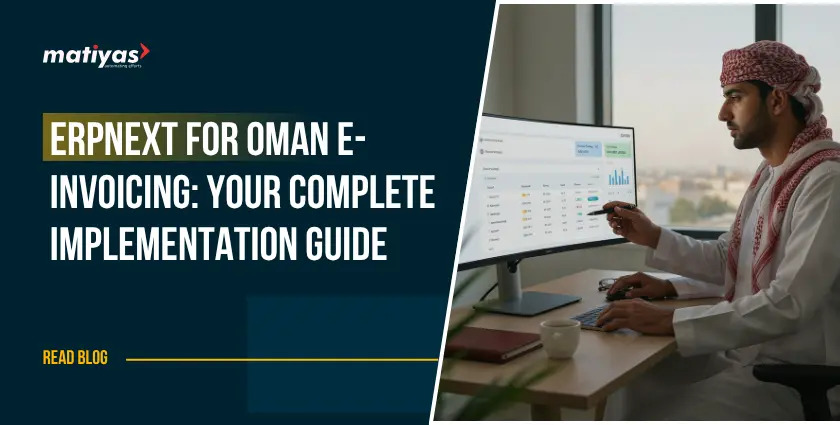
As Oman’s Fawtara e-invoicing system rolls out in phases starting August 2026, VAT-registered businesses face a critical decision: how to prepare their systems for compliance. Among the solutions available, ERPNext stands out as a powerful, cost-effective, and flexible option for businesses looking to automate their invoicing and ensure seamless Fawtara integration.
This comprehensive guide explores ERPNext’s capabilities for Oman e-invoicing, implementation strategies, and why many businesses are choosing this open-source ERP platform as their foundation for Fawtara compliance.
What is ERPNext?
ERPNext is a comprehensive, open-source Enterprise Resource Planning (ERP) platform built on the Frappe Framework. Unlike expensive proprietary systems, ERPNext offers businesses a complete solution without per-user licensing fees or hidden paywalls.
Key Characteristics of ERPNext:
- 100% Open-Source: Released under GPLv3 license, available free on GitHub
- Built on Frappe Framework: Python and JavaScript foundation enabling customization
- Low Cost: No subscription fees or per-user penalties
- Comprehensive Modules: Accounting, sales, purchasing, inventory, manufacturing, HR, and e-invoicing
- Global Adoption: Powering businesses across 150+ countries
- Community-Driven: Active international community and growing partner network
- Self-Hosted or Cloud: Deploy on-premise or use Frappe Cloud managed services
ERPNext is particularly suited for small to mid-sized businesses (SMBs) and growing enterprises that need enterprise-level functionality without enterprise-level pricing.
Why ERPNext for Oman e-Invoicing?
Several factors make ERPNext an excellent choice for Fawtara compliance:
1. Integrated Invoicing Capabilities
ERPNext includes comprehensive invoicing functionality built into its core accounting module. Rather than bolting on e-invoicing as an afterthought, the platform natively supports:
- Automated invoice generation from sales orders
- Customizable invoice templates and print formats
- Multi-currency invoicing
- Tax handling and VAT compliance
- Accounts receivable tracking
- Payment reconciliation and follow-up automation
2. Flexibility for Customization
The open-source nature of ERPNext means you’re not locked into rigid workflows. The platform can be customized to meet Oman’s specific requirements:
- Add custom fields for Fawtara-specific data
- Modify workflows to align with five-corner model requirements
- Create custom report formats for OTA submissions
- Build integration logic specific to your service provider
3. Lower Total Cost of Ownership
For businesses concerned about implementation costs:
- No licensing fees regardless of user count
- Lower cloud hosting costs compared to SaaS alternatives
- Reduced consultant costs due to active community and documentation
- No recurring per-user subscription increases
- Open access to source code eliminates vendor lock-in
4. Seamless Integration with Service Providers
ERPNext’s API-first architecture enables smooth integration with OTA-accredited service providers:
- RESTful API for connecting to Fawtara service providers
- Webhook capabilities for receiving acknowledgments and validations
- Custom scripts for transforming invoice data to required XML/JSON formats
- Real-time status tracking of submitted invoices
5. Data Integrity and Compliance
ERPNext provides the foundational infrastructure for Fawtara compliance:
- Complete audit trails for all transactions
- Digital signature support for cryptographic signing
- 10-year data archival capabilities with organized storage
- Role-based access control for sensitive operations
- Built-in compliance tracking and reporting
ERPNext Architecture for Fawtara e-Invoicing
Understanding how ERPNext fits into the Fawtara five-corner model is essential for successful implementation:
The Five-Corner Model with ERPNext:
Corner 1 – Supplier System (ERPNext):
- Create and manage invoices in ERPNext
- Ensure all mandatory Fawtara fields are populated
- Generate structured invoice data (XML/JSON format)
- Apply digital signatures and unique IDs
- Maintain complete audit trail of invoice lifecycle
Corner 2 – Supplier’s Service Provider:
- Receive structured invoice data from ERPNext
- Validate invoice format and compliance
- Apply service provider-specific processing
- Prepare invoice for secure transmission
Corner 3 – Exchange Layer (Fawtara):
- Secure routing of invoices between service providers
- OTA validation and verification
- Real-time acknowledgment generation
- Regulatory visibility and compliance monitoring
Corner 4 – Customer’s Service Provider:
- Receive validated invoice data from Fawtara
- Transform data for customer’s system
- Send acknowledgment back to supplier’s service provider
- Archive invoice for customer’s records
Corner 5 – Customer System (ERPNext):
- Receive invoice data from service provider
- Automatically populate accounts payable records
- Match invoices with purchase orders
- Process payments and reconcile accounts
ERPNext Modules for Fawtara Compliance
Here’s how ERPNext’s key modules support Fawtara implementation:
Accounting Module
Core Functionality:
- General ledger management with hierarchical chart of accounts
- Accounts receivable (AR) for sales invoices
- Accounts payable (AP) for purchased invoices
- Multi-currency support
- Tax handling including VAT
- Period-close processes
Fawtara Integration Points:
- Create and customize sales invoices with Fawtara-required fields
- Track invoice status through entire five-corner flow
- Monitor tax compliance in real-time
- Generate compliance reports for OTA
- Maintain 10-year digital archive with proper organization
Sales Module
Core Functionality:
- Lead and opportunity management
- Quotation generation
- Sales order creation
- Automated invoicing from sales orders
- Customer relationship management
- Automated payment reminders
Fawtara Integration Points:
- Automate invoice creation for e-submission
- Enforce business rules for Fawtara compliance
- Track invoice submission status
- Manage customer acknowledgments
- Document invoice amendments and corrections
Accounts Receivable
Core Functionality:
- Invoice tracking and status monitoring
- Payment reconciliation
- Aging analysis
- Automated payment reminders
- Dunning management
- Late payment notifications
Fawtara Integration Points:
- Monitor payment status post-invoice submission
- Track acknowledgments from customers
- Manage invoice amendments and corrections
- Reconcile received amounts with submitted invoices
- Generate compliance confirmation reports
Customizable Fields and Workflows
ERPNext allows you to:
- Add Fawtara-specific fields (QR codes, unique IDs, etc.)
- Enforce mandatory data entry for compliance
- Create validation rules before submission
- Automate XML/JSON conversion
- Trigger service provider API calls
- Log all compliance-related events
Implementation Strategy: ERPNext for Fawtara
Successfully implementing ERPNext for Fawtara compliance requires a structured approach:
Phase 1: Planning and Assessment (Weeks 1-3)
Activities:
- Audit current invoicing processes and pain points
- Determine compliance phase (use OTA VATIN-based rollout checker)
- Map current invoice data to Fawtara requirements
- Identify integration points with chosen service provider
- Assess technical capabilities and resource availability
- Define project scope and timeline
Deliverables:
- System requirements document
- Process flow diagrams for Fawtara integration
- Data mapping specifications
- Risk assessment and mitigation plan
- Resource allocation and budget
Phase 2: System Setup (Weeks 3-6)
Activities:
- Install ERPNext (self-hosted or Frappe Cloud)
- Configure chart of accounts for Oman tax requirements
- Set up company and branch structures
- Configure customer and vendor master data
- Establish tax categories and rates
- Define invoice numbering and document sequences
Deliverables:
- Configured ERPNext instance
- Completed company setup
- Master data import
- Tax configuration
- Invoice template setup
Phase 3: Customization for Fawtara (Weeks 5-9)
Activities:
- Add Fawtara-specific custom fields to invoice doctype
- Create validation rules for mandatory fields
- Build data transformation logic for XML/JSON export
- Integrate digital signature module
- Set up QR code generation
- Configure Unique Invoice ID (UII) generation
- Create service provider API integration
Key Customizations:
- Custom Fields: Add fields for Fawtara-required data (tax identifier, invoice line details, etc.)
- Workflow States: Create invoice status tracking through five-corner model
- Validation Rules: Enforce OTA requirements before submission
- API Integration: Connect to service provider for automated submission
- Acknowledgment Handler: Process service provider responses automatically
- Compliance Reports: Generate audit-ready documentation
Phase 4: Integration with Service Provider (Weeks 8-11)
Activities:
- Connect ERPNext API to chosen OTA-accredited service provider
- Test invoice submission and acknowledgment receipt
- Validate data transformation to required formats
- Test error handling and correction workflows
- Implement retry logic for failed submissions
- Set up monitoring and alerting
Testing Scenarios:
- Successful invoice submission and acknowledgment
- Invalid invoice rejection and correction
- Service provider downtime handling
- Duplicate invoice prevention
- Amendment and credit note processing
- High-volume submission testing
Phase 5: Data Migration and Parallel Run (Weeks 11-13)
Activities:
- Migrate historical invoice data if needed
- Set up parallel invoicing (ERPNext + legacy system)
- Run in parallel for 2-4 weeks
- Monitor for discrepancies and issues
- Validate invoice data accuracy
- Verify service provider integration
Phase 6: Staff Training and Go-Live (Weeks 12-14)
Activities:
- Train finance team on ERPNext invoicing
- Train accounting team on approval workflows
- Train IT staff on system monitoring
- Create user documentation and quick-start guides
- Conduct user acceptance testing (UAT)
- Address feedback and make final adjustments
- Execute cutover to ERPNext for live invoicing
Training Content:
- Creating sales invoices in ERPNext
- Understanding Fawtara compliance requirements
- Managing invoice approvals and submissions
- Monitoring submission status
- Processing acknowledgments and corrections
- Troubleshooting common issues
Phase 7: Post-Go-Live Support (Ongoing)
Activities:
- Monitor system performance and errors
- Provide user support during transition
- Optimize workflows based on real-world usage
- Maintain compliance through regular audits
- Stay current with OTA updates and requirements
- Plan for future enhancements
Real-World Use Cases: ERPNext for Fawtara
Case Study 1: Manufacturing Company (50 employees)
Challenge: Existing manual invoicing system unable to handle Fawtara requirements; high risk of non-compliance.
Solution:
- Implemented ERPNext for end-to-end invoice management
- Integrated with OTA-accredited service provider via API
- Automated invoice generation from manufacturing production orders
- Added custom fields for Fawtara-specific requirements
Results:
- 75% reduction in invoicing time
- Zero invoice rejections after go-live
- Automated compliance verification
- 5-year ROI through efficiency gains
Case Study 2: Wholesale Distributor (200+ invoices/month)
Challenge: High invoice volume requiring manual processing; SaaS solution costs prohibitive.
Solution:
- Deployed ERPNext for inventory and invoicing
- Built automated batch submission to Fawtara
- Integrated with warehouse management system
- Customized reports for business intelligence
Results:
- Reduced manual work by 80%
- Batch processing reduced submission time from hours to minutes
- Enhanced visibility into revenue trends
- Cost savings of $40,000+ annually
Case Study 3: Service Company (B2B focus)
Challenge: Complex billing for various service types; need for detailed invoice customization.
Solution:
- Implemented ERPNext with custom invoice templates
- Set up project-based invoicing workflows
- Integrated time tracking with invoice generation
- Built custom reports for project profitability
Results:
- Accurate project billing and cost tracking
- Faster invoice generation (2 hours → 15 minutes)
- Improved profitability visibility
- Better customer communications through automated invoicing
Challenges and Solutions
While ERPNext is powerful, businesses should be aware of potential challenges:
Challenge 1: Technical Expertise Required
Issue: ERPNext requires more technical knowledge than point-and-click SaaS solutions.
Solution:
- Hire experienced Frappe partners for implementation
- Invest in staff training on Python/JavaScript if self-hosting
- Use Frappe Cloud managed hosting to reduce operational complexity
- Leverage community forums and documentation
Challenge 2: Customization Complexity
Issue: Fawtara-specific customizations require development skill.
Solution:
- Work with partners experienced in Oman e-invoicing
- Use ERPNext’s low-code/no-code builder for simple customizations
- Document customizations thoroughly for maintenance
- Plan for version updates and customization maintenance
Challenge 3: Service Provider Integration
Issue: Integration approaches vary by service provider.
Solution:
- Choose service provider experienced with ERPNext integrations
- Get detailed API documentation from service provider
- Build modular integration code for maintainability
- Establish test environment for ongoing validation
Challenge 4: Ongoing Maintenance
Issue: Self-hosted ERPNext requires ongoing maintenance and updates.
Solution:
- Use Frappe Cloud for managed hosting (eliminates ops complexity)
- Plan for regular updates and testing
- Maintain comprehensive documentation
- Budget for annual support and maintenance
Choosing the Right Service Provider for ERPNext
Not all OTA-accredited service providers have ERPNext integration experience. When evaluating providers, ask:
Technical Integration Questions:
- Do you have existing ERPNext integrations?
- What’s your API documentation quality?
- Can you support XML/JSON transformation?
- How do you handle acknowledgments and error responses?
- What’s your integration timeline (target: 5-7 days)?
Support and Service Questions:
- Do you provide integration support during implementation?
- What’s your technical support availability (24/7 preferred)?
- How do you handle service outages?
- What’s your incident response time?
Compliance Questions:
- How do you ensure invoice validation before submission?
- What’s your success rate for first-time submission?
- How do you handle rejected invoices?
- What compliance reports do you provide?
Cost Structure Questions:
- What’s your pricing model (per-invoice, monthly, volume-based)?
- Are there implementation fees?
- What’s included in basic vs. premium support?
Best Practices for ERPNext Fawtara Implementation
1. Start Early, Don’t Wait Until Deadline
The August 2026 Phase 1 pilot won’t wait for you. Begin assessment and planning in 2025 to avoid rushed implementation.
2. Maintain Complete Audit Trails
ERPNext’s audit capabilities are powerful leverage them:
- Track all invoice modifications
- Document approval workflows
- Record service provider interactions
- Maintain version history for compliance
3. Test Extensively in Sandbox
Before going live:
- Test all invoice types and scenarios
- Validate high-volume processing
- Test error handling and corrections
- Verify service provider acknowledgment handling
4. Plan for Amendments and Credits
Invoices often require amendments:
- Design workflows for credit notes
- Plan for debit notes and adjustments
- Test amendment submission through Fawtara
- Document amendment procedures for staff
5. Monitor Compliance Continuously
Don’t treat compliance as a one-time task:
- Create compliance dashboards
- Monitor submission success rates
- Track rejected invoices and reasons
- Generate regular compliance reports for management
6. Plan for Growth
Design your ERPNext instance for future expansion:
- Use modular customization approach
- Plan for multi-company/multi-branch scenarios
- Consider future transaction volume
- Build scalability into your architecture
Getting Started with ERPNext for Fawtara
Step 1: Evaluation (1-2 weeks)
- Review ERPNext features and pricing
- Assess your technical team’s capabilities
- Identify gaps vs. requirements
- Calculate ROI vs. alternative solutions
- Make build-vs-buy decision
Step 2: Partner Selection (1-2 weeks)
- Research ERPNext and Frappe partners
- Look for Oman/MENA expertise
- Review case studies and references
- Evaluate technical capabilities
- Negotiate implementation plan and pricing
Step 3: Planning and Design (2-3 weeks)
- Document current invoicing processes
- Map requirements to ERPNext functionality
- Design Fawtara integration architecture
- Create detailed project plan
- Define success criteria
Step 4: Implementation (8-12 weeks)
- Follow structured implementation phases
- Maintain regular progress reviews
- Test continuously
- Involve stakeholders in UAT
- Plan and execute go-live
Step 5: Go-Live and Optimization (4+ weeks)
- Execute careful cutover to live invoicing
- Monitor system performance
- Provide user support during transition
- Optimize workflows
- Plan for continuous improvement
The Future: ERPNext Roadmap for E-Invoicing
ERPNext’s roadmap includes continued e-invoicing enhancements:
Planned Improvements:
- Enhanced e-invoicing module with multi-country support
- Simplified integration with global e-invoicing standards
- Improved compliance reporting capabilities
- Better QR code and digital signature handling
- Industry-specific e-invoicing templates
- Enhanced audit trail and compliance tracking
As Fawtara matures and potentially adopts international standards (like Peppol), ERPNext’s open architecture positions it well to adapt to evolving requirements.
Conclusion
As Oman’s Fawtara system rolls out in phases, businesses need robust, flexible, and cost-effective solutions to ensure compliance. ERPNext emerges as a powerful choice for organizations looking to:
- Automate invoicing and reduce manual work
- Ensure compliance with real-time validation
- Minimize costs compared to proprietary alternatives
- Maintain flexibility to adapt to changing requirements
- Avoid vendor lock-in through open-source architecture
The platform’s comprehensive invoicing capabilities, combined with its flexibility for customization and integration with OTA-accredited service providers, make it an excellent foundation for Fawtara compliance.
The key to success is starting early, choosing the right implementation partner, and approaching the project systematically. For businesses that invest in proper planning and execution, ERPNext can transform invoicing from a compliance burden into a competitive advantage.
The Bottom Line: ERPNext for Oman e-invoicing isn’t just a technical choice, it’s a strategic decision that positions your business for sustainable, scalable success in a digital-first economy.
Ready to implement ERPNext for Fawtara?
Start your assessment today. Connect with an experienced Frappe partner with MENA expertise, evaluate your business processes, and create a roadmap for successful implementation. The sooner you start, the more prepared you’ll be for Fawtara compliance.
Frequently Asked Questions



 "I am quite happy with the ERP solution provided by Matiyas. Before we implemented their system, our organization was struggling with inefficient processes and fragmented data. Their customized ERP solution not only streamlined our workflows but also provided real-time insights into our operations. The customer support from Matiya's Team has been exceptional throughout the journey."
 "Matiyas offered us a functionally strong and automated solution to address the end-to-end needs of our business operation. This solutions will be able to scale and grow our business and it will surely reduce manual interventions."
 "I wanted to thank you Matiyas team to set-up the ERP system based on our business process. The assistance was invaluable in helping my company get as we requested. We sincerely appreciate your efforts and thanks again Matiyas team to provide us a best solution with the erp system."

 "The implementation of the Matiyas ERP solution has revolutionized our workflow. The automation of previously manual processes has not only saved us time but also significantly reduced errors. It’s like having an extra set of hands on our team, streamlining operations and boosting productivity"



 "Our company is very new to ERP, we tried to implement ERP by ourselves, however along the way we found struggles as we are very new. We are lucky HasanAli from Matiyas helped us in many ways, from a simple question to very complex developments and deployments. Rates are reasonable too! We are happy that Matiyas is there to help us."
 "The folks at Matiyas Software are the best. They're skilled, work quickly and professionally, and were able to tailor ERP to our exact specifications. Would use them again."
 "Very knowledgeable and prompt and professional. I highly recommend Matiyas for any ERP customizations."