


About the Client
Vimal Nova is an Indian-based manufacturing company specializing in production and stock management across multiple warehouse locations. As a growing mid-sized manufacturer, the organization operates with a lean, efficiency first philosophy which meant that adopting an enterprise resource planning (ERP) system was only on the table if it could be customized precisely to their operational model, without forcing wholesale changes to processes that were already working.
The company manages a mix of raw material inputs, repacking workflows, and finished goods distribution. Their Production and Inventory Manager oversees a team responsible for keeping factory output aligned with centralized stock records, a coordination challenge that was increasingly difficult to manage through manual processes and siloed tools.
The Challenge
Before engaging Matiyas, Vimal Nova’s operations were constrained by a set of interconnected challenges that were compounding over time. Each problem in isolation was manageable; together, they were limiting the company’s ability to scale effectively.
1. Disconnected Factory and Office Operations
The factory floor and the centralized administrative workspace operated as two separate islands of information. When production runs were completed, stock movements were recorded manually often with a delay of hours. This meant that the inventory team in the office was routinely making procurement and planning decisions based on data that was already out of date. The lag created friction, duplication of effort, and occasional over-ordering or under-ordering of critical materials.
2. Manual, Error-Prone Inventory Tracking
Stock records were maintained through spreadsheets and manual entries, a process that introduced consistent inaccuracies. Reconciling physical stock counts with system records was time-consuming and frequently revealed discrepancies. Staff spent significant time on administrative correction rather than on value-adding tasks. The risk of errors in repack quantities and warehouse transfers was particularly acute.
3. No Automated Reorder Management
Without automated reorder level triggers, the team relied entirely on manual stock checks to identify when materials were running low. This reactive approach led to periodic stock-outs that halted production lines, as well as emergency procurement situations that were costly and stressful. There was no structured mechanism to generate Purchase Orders when stock fell below a defined threshold.
4. Unstructured Manufacturing Processes
On the production side, work orders, Bill of Materials (BOM) management, and job card tracking were handled informally. There was no systematic way to link raw material consumption to finished goods output, making it difficult to calculate production costs accurately or identify inefficiencies in the manufacturing process. Supervisors relied on tribal knowledge rather than structured data to make scheduling decisions.
Why Matiyas?
• Consultative Pre-Sales Approach: The Matiyas team invested time in understanding Vimal Nova’s operations before proposing a solution, ensuring the implementation matched their real workflows.
• Right-Sized ERP Implementation: Instead of recommending a full ERP suite, Matiyas advised a focused deployment with only the modules the client actually needed.
• Strong ERPNext Customization Expertise: Deep technical knowledge of ERPNext assured Vimal Nova that the system would adapt to their processes—not force them to change how they work.
• Transparent & Trust-Driven Engagement: The team’s honesty in recommending “less rather than more” built credibility and trust during the evaluation phase.
• Dedicated Support & Technical Guidance: Proactive involvement from the team, especially David, helped address operational and technical concerns before implementation began.
The Solution
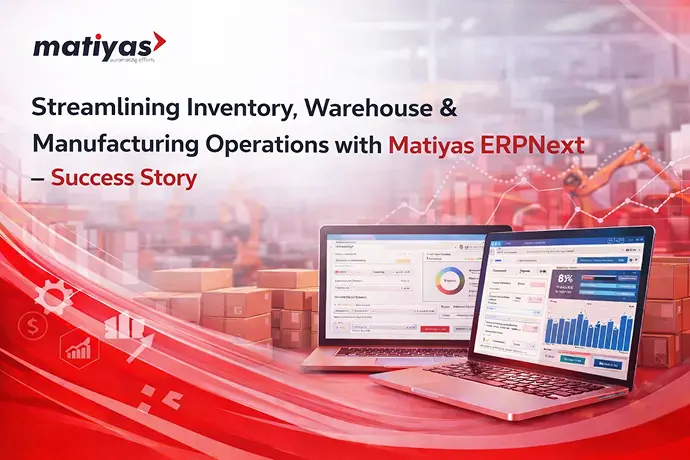
Matiyas implemented a customized ERPNext deployment covering two integrated modules: Inventory & Warehouse Management and Manufacturing. Together, these modules formed a connected operational backbone for Vimal Nova’s production and stock environment.
Module 1: Inventory & Warehouse Management
• Stock Management: Real-time tracking of all stock items across warehouse locations, with full visibility into stock-in, stock-out, and transfer movements.
• Warehouse Configuration: Multi-warehouse setup with dedicated storage bins and location-based tracking, ensuring accurate physical-to-system alignment.
• Reorder Level Automation: Configurable minimum stock thresholds per item, triggering automated reorder alerts and enabling Purchase Order generation directly from stock data without requiring the financial module to be active.
• Repack Operations: Structured workflows to manage the transformation of bulk materials into smaller units or alternate packaging configurations, with accurate quantity deduction and output recording.
Module 2: Manufacturing
• Bill of Materials (BOM) Management: Structured BOM creation for all finished goods, defining raw material inputs, quantities, and sub-assemblies required for each production run.
• Work Order Management: Digital work orders linked to BOMs, enabling production supervisors to initiate, track, and close production runs with full material consumption visibility.
• Job Card Tracking: Granular-level tracking of individual tasks within a production run, providing time and progress data at the operator level and enabling more accurate production cost calculations.
• Raw Material Consumption Linkage: Automatic deduction of raw materials from inventory upon work order completion, ensuring that production activity is immediately and accurately reflected in stock records.
• Factory to Office Connectivity: A unified system connecting production floor activity with centralized inventory and planning, eliminating the data lag that had previously hindered decision making.
Implementation Journey
The implementation was phased to minimize disruption to ongoing operations. Matiyas began with a detailed discovery session to map Vimal Nova’s existing workflows, identify gaps, and define the customization scope. This groundwork was essential — it ensured the system was built around how Vimal Nova actually worked, not a textbook ideal.
The inventory module was deployed first, establishing the data foundation. Warehouse structures, item masters, and opening stock entries were configured and validated before go-live. The manufacturing module followed, with BOM and work order workflows built and tested in parallel with live operations.
The Vimal Nova team acknowledges that the on-boarding process required a meaningful investment of time and attention in the early weeks. This is consistent with any structured system implementation. The Matiyas team provided close, hands-on support throughout — running training sessions, resolving configuration queries promptly, and iterating on workflows based on user feedback. By the time the system went live, the team felt confident and prepared.
Results at a Glance
The following key performance improvements were observed following the Matiyas ERPNext implementation:
| KPI | Improvement | Description |
|---|---|---|
| Inventory Accuracy | ↑ Significantly | Real-time stock updates replaced delayed manual entries, reducing discrepancies between physical and system records. |
| Stock Replenishment Speed | ↑ Faster | Automated reorder alerts eliminated reactive, emergency procurement — enabling planned, timely Purchase Orders. |
| Production-to-Inventory Sync | Near Real-Time | Work order completion now automatically deducts raw materials and updates finished goods, closing the data lag entirely. |
| Repack Process Efficiency | ↑ Improved | Structured digital workflows replaced ad hoc manual recording, reducing errors in repack quantities and output logs. |
| Factory-Office Coordination | Unified | Single system view eliminated the need for duplicate data entry across production floor and central office teams. |
| Decision-Making Speed | ↑ Faster | Managers now have live inventory and production data, enabling faster and more confident planning and procurement decisions. |
| Manual Administrative Load | ↓ Reduced | Staff time previously spent on stock reconciliation and manual correction is now redirected to operational activities. |
Results & Impact
The impact of the Matiyas implementation is felt most clearly in the quality of day-to-day coordination between Vimal Nova’s factory floor and its administrative teams. What was previously a slow, error-prone exchange of manual updates has become a connected, real-time information flow. When a production run is completed or a repack is processed, the change is immediately visible across the system — no delays, no telephone calls, no spreadsheet updates.
On the manufacturing side, work orders are now initiated with a complete BOM-linked view of required materials. Production supervisors know at the point of scheduling whether sufficient raw materials are available, preventing mid-run disruptions. Job card tracking provides accountability at the operator level and gives management the data needed to identify bottlenecks and improve throughput over time.
Stock replenishment has shifted from reactive to proactive. The automated reorder level system means that the purchasing team receives alerts before stock-outs occur, giving them adequate lead time to source materials at normal commercial terms rather than under emergency conditions. This shift alone has reduced procurement stress and is expected to yield cost savings through more favourable purchasing cycles.
Perhaps most significantly, managers now have reliable, live data on which to base decisions. The confidence that comes from knowing the system reflects reality — rather than an approximation of it — has changed the tenor of planning conversations within the organization.
Looking Ahead
Vimal Nova’s feedback has already informed one meaningful product enhancement under consideration: the ability to generate Purchase Orders triggered by stock reorder levels without requiring the financial module to be active. This capability would make the solution even more accessible to manufacturers who want operations-level ERP functionality without committing to a full financial system integration at the outset.
Looking further ahead, Vimal Nova is positioned to expand their ERPNext footprint as the business grows. The modular architecture of their current implementation means that additional capabilities — whether in quality control, procurement management, or financial reporting — can be layered on top of the existing foundation without requiring a system replacement.
Advice to Other Organizations
Vimal Nova’s Production and Inventory Manager offers straightforward advice to other manufacturers considering an ERP implementation: “Give it a try.” Behind that brevity is a considered perspective.
The team acknowledges that the early phases of any ERP implementation require commitment — time to configure the system, discipline to enter data correctly, and patience as new workflows replace familiar habits. But they are equally clear that this investment is worthwhile. Once the system is embedded, the return in terms of visibility, control, and operational confidence is substantial.
For organizations worried that they “don’t need the whole ERP,” Vimal Nova’s experience is a direct counter-argument to inaction. The right implementation partner can scope a solution that is precisely sized for your current needs — and that grows with you.
Ready to streamline your inventory and production?
See how a focused ERPNext implementation can eliminate manual processes, improve stock accuracy, and connect your Enterprise and office in real time.
Client Feedback
| “We did not need the whole ERP but a very small part of it, which Matiyas were able to help us with. It takes a bit of effort in the start, but at the end, the product is worth the effort. The team’s dedication, especially David, in clearing our doubts made all the difference.” — Production & Inventory Manager, Vimal Nova |

 "I am quite happy with the ERP solution provided by Matiyas. Before we implemented their system, our organization was struggling with inefficient processes and fragmented data. Their customized ERP solution not only streamlined our workflows but also provided real-time insights into our operations. The customer support from Matiya's Team has been exceptional throughout the journey."
 "Matiyas offered us a functionally strong and automated solution to address the end-to-end needs of our business operation. This solutions will be able to scale and grow our business and it will surely reduce manual interventions."
 "I wanted to thank you Matiyas team to set-up the ERP system based on our business process. The assistance was invaluable in helping my company get as we requested. We sincerely appreciate your efforts and thanks again Matiyas team to provide us a best solution with the erp system."

 "The implementation of the Matiyas ERP solution has revolutionized our workflow. The automation of previously manual processes has not only saved us time but also significantly reduced errors. It’s like having an extra set of hands on our team, streamlining operations and boosting productivity"



 "Our company is very new to ERP, we tried to implement ERP by ourselves, however along the way we found struggles as we are very new. We are lucky HasanAli from Matiyas helped us in many ways, from a simple question to very complex developments and deployments. Rates are reasonable too! We are happy that Matiyas is there to help us."
 "The folks at Matiyas Software are the best. They're skilled, work quickly and professionally, and were able to tailor ERP to our exact specifications. Would use them again."
 "Very knowledgeable and prompt and professional. I highly recommend Matiyas for any ERP customizations."