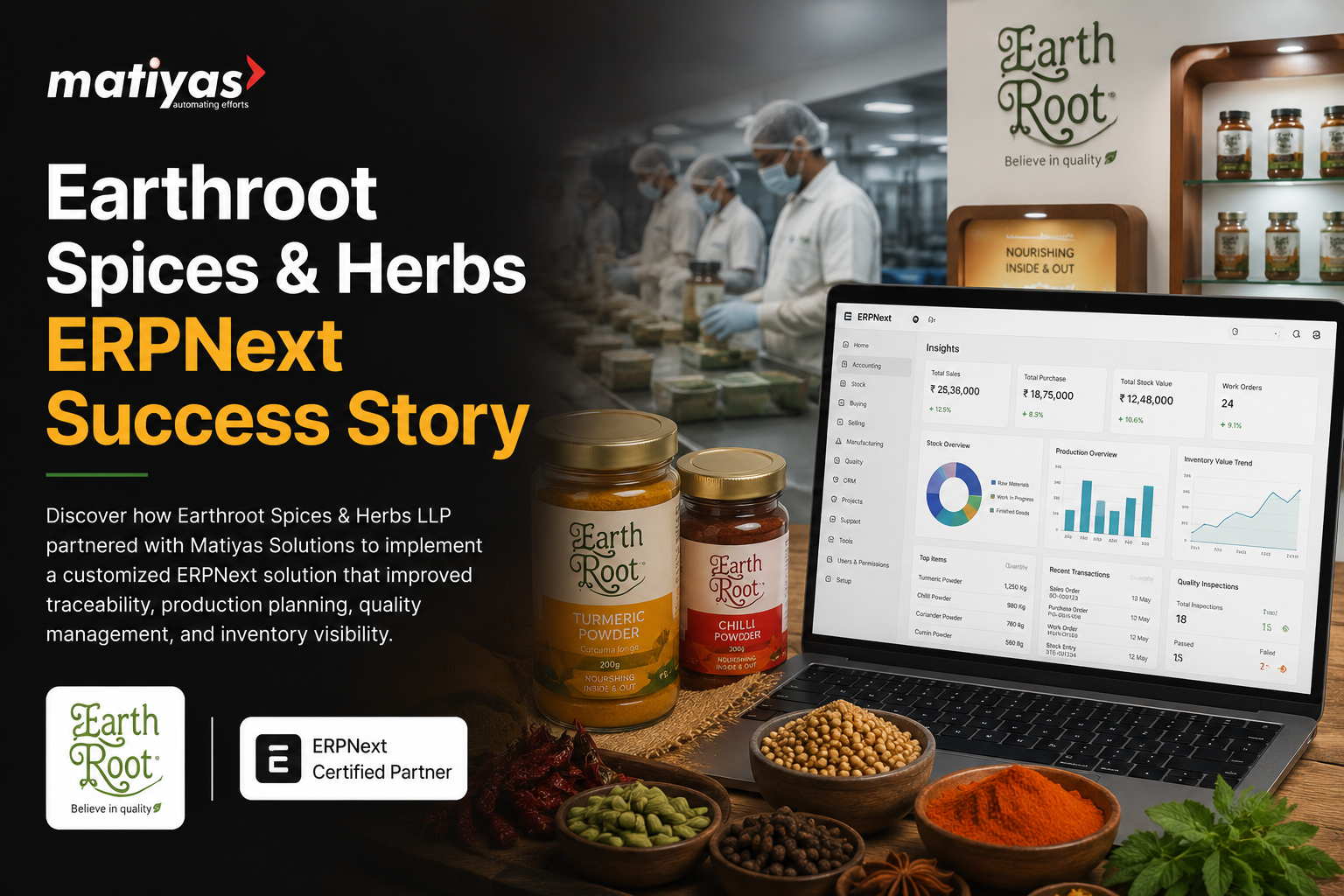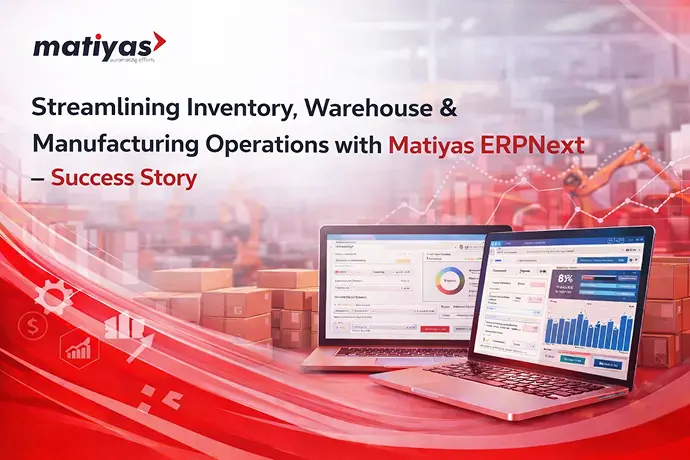

Streamlining Inventory, Warehouse & Manufacturing Operations for Vimal Nova with Matiyas ERPNext

Transforming Grocery Distribution for Kirana Stores Through Seamless Multi Platform Integration

ERPNext Customization & Malaysia E-Invoicing Implementation

ERPNext Manufacturing Customization Success Story

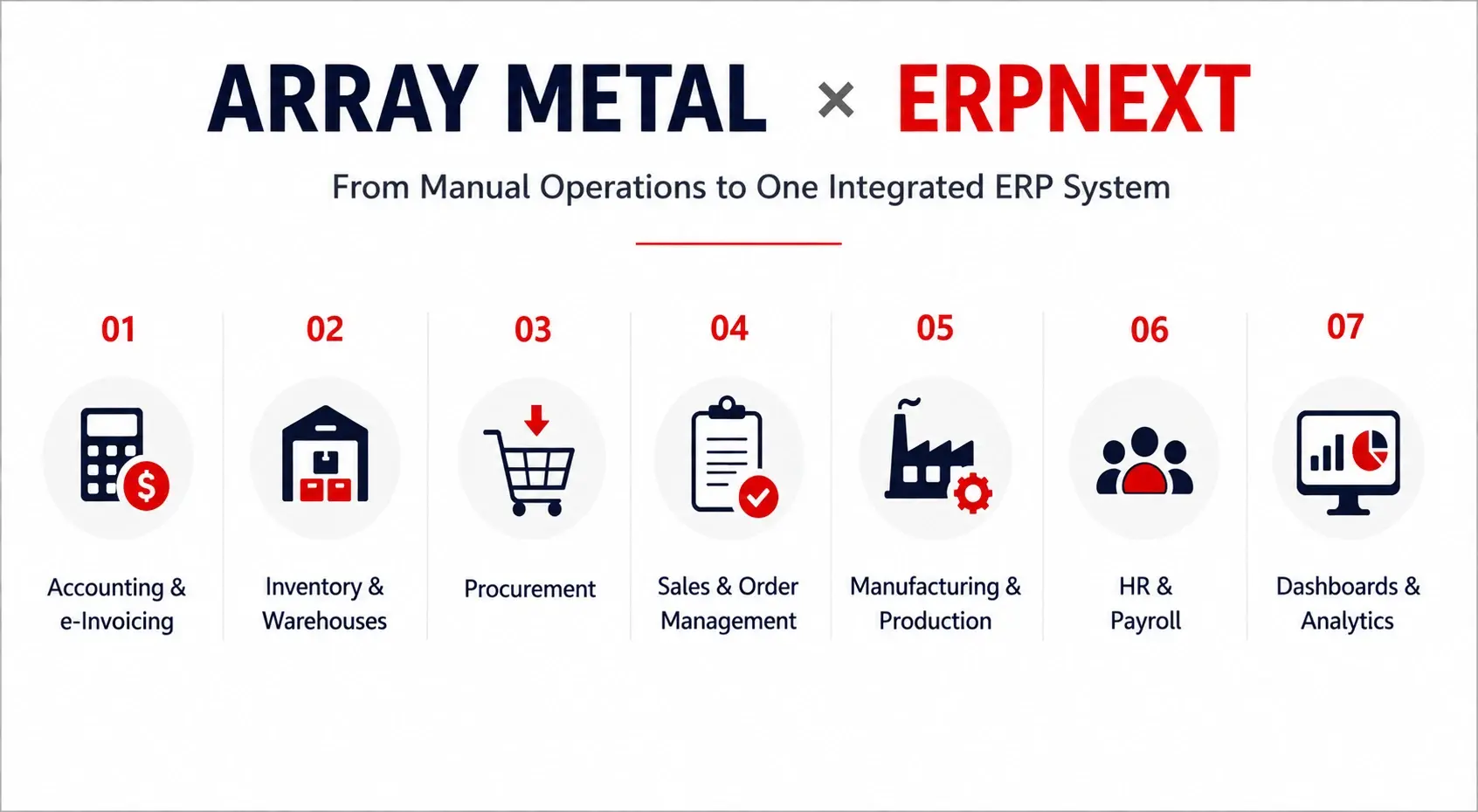
Manufacturing ERP Success Story: Integrated Production, Sales & Finance

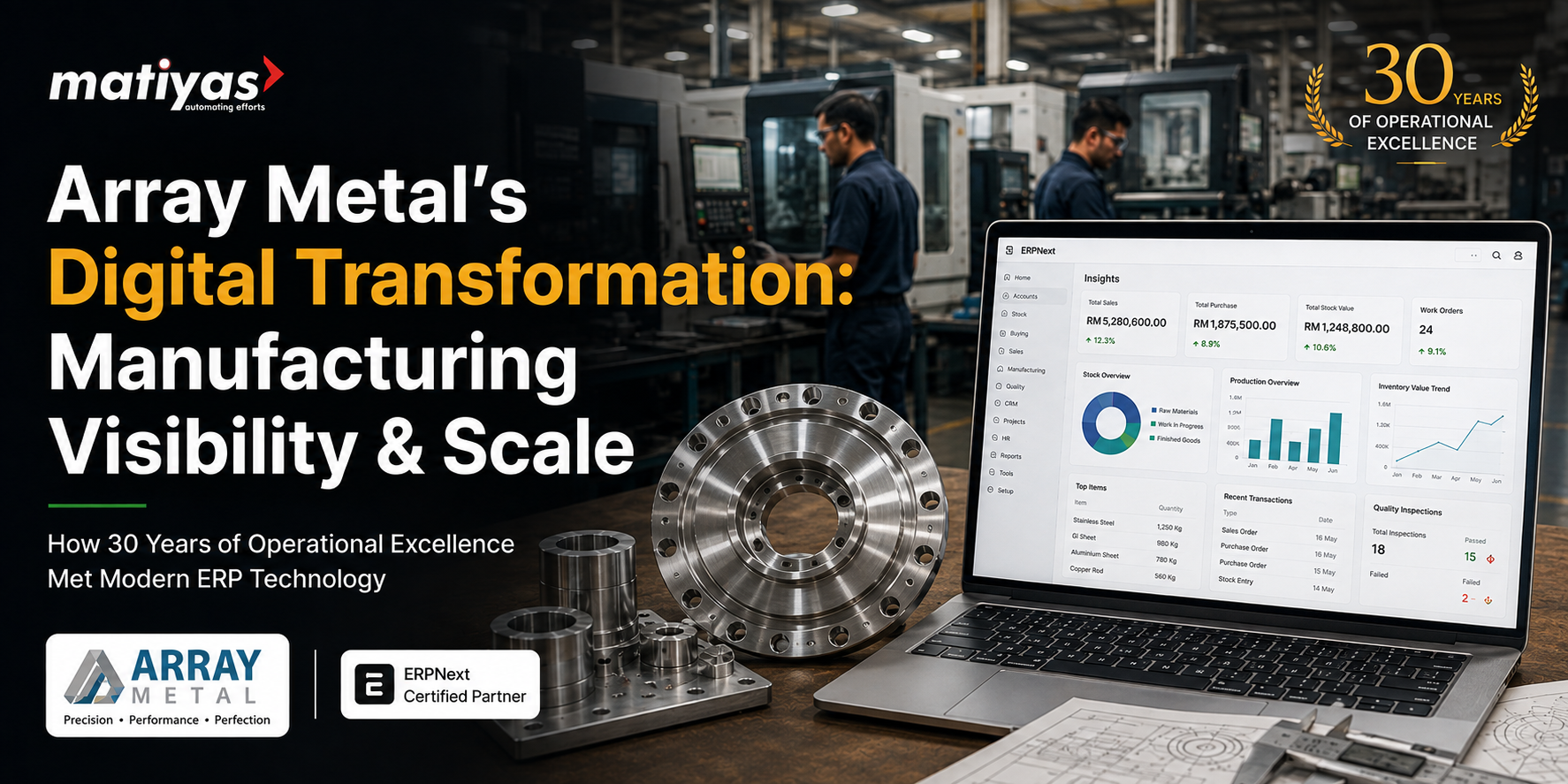
Digital Transformation in Manufacturing: Wunderkraf’s ERPNext Journey

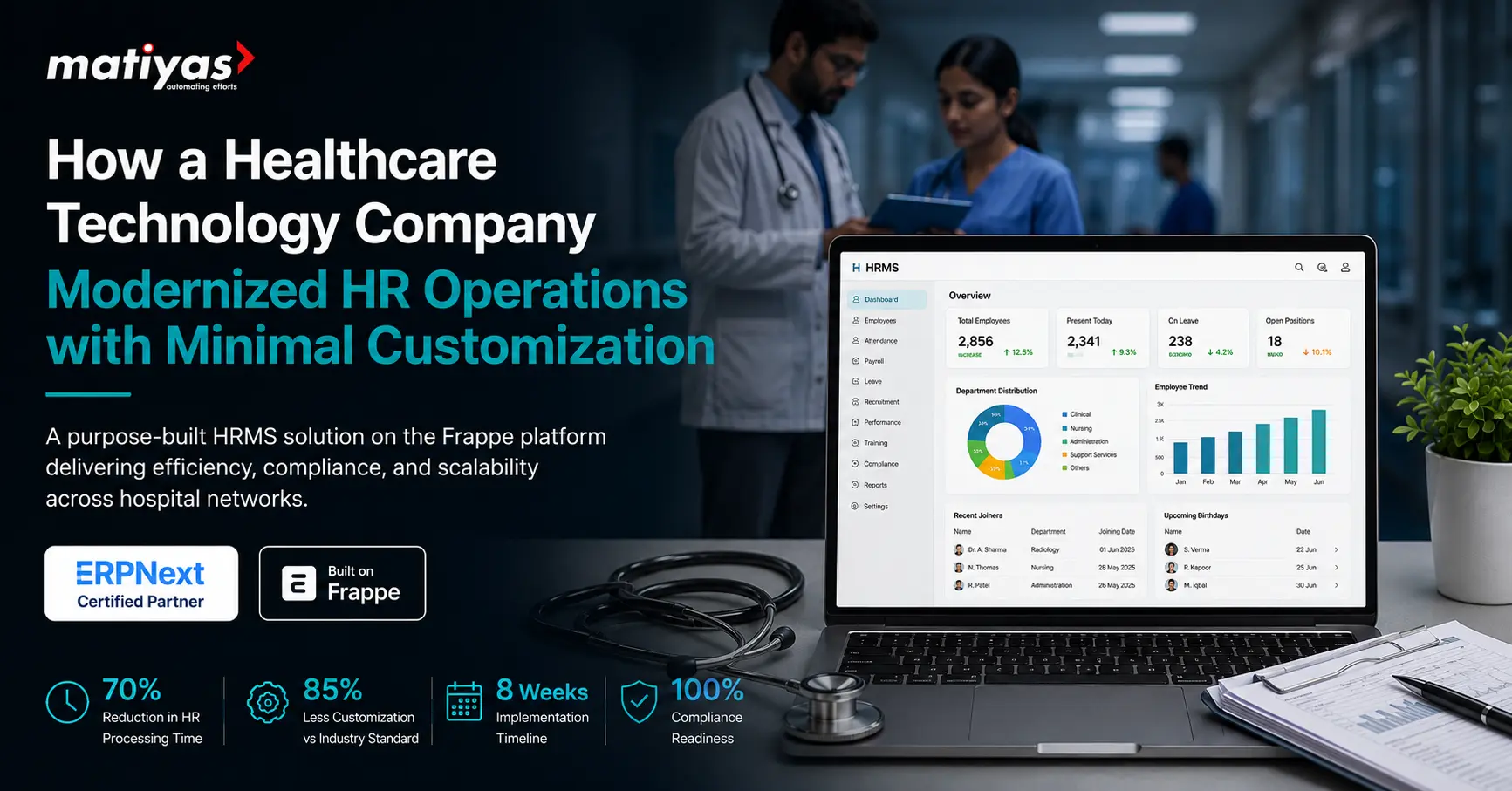
ERPNext manufacturing and inventory case study banner showing warehouse, stock management and ERP dashboard by Matiyas

About the Client

Vimal Nova is an Indian-based manufacturing company specializing in production and stock management across multiple warehouse locations. As a growing mid-sized manufacturer, the organization operates with a lean, efficiency first philosophy which meant that adopting an enterprise resource planning (ERP) system was only on the table if it could be customized precisely to their operational model, without forcing wholesale changes to processes that were already working.

The company manages a mix of raw material inputs, repacking workflows, and finished goods distribution. Their Production and Inventory Manager oversees a team responsible for keeping factory output aligned with centralized stock records, a coordination challenge that was increasingly difficult to manage through manual processes and siloed tools.

The Challenge

Before engaging Matiyas, Vimal Nova’s operations were constrained by a set of interconnected challenges that were compounding over time. Each problem in isolation was manageable; together, they were limiting the company’s ability to scale effectively.

1. Disconnected Factory and Office Operations

The factory floor and the centralized administrative workspace operated as two separate islands of information. When production runs were completed, stock movements were recorded manually often with a delay of hours. This meant that the inventory team in the office was routinely making procurement and planning decisions based on data that was already out of date. The lag created friction, duplication of effort, and occasional over-ordering or under-ordering of critical materials.

2. Manual, Error-Prone Inventory Tracking

Stock records were maintained through spreadsheets and manual entries, a process that introduced consistent inaccuracies. Reconciling physical stock counts with system records was time-consuming and frequently revealed discrepancies. Staff spent significant time on administrative correction rather than on value-adding tasks. The risk of errors in repack quantities and warehouse transfers was particularly acute.

3. No Automated Reorder Management

Without automated reorder level triggers, the team relied entirely on manual stock checks to identify when materials were running low. This reactive approach led to periodic stock-outs that halted production lines, as well as emergency procurement situations that were costly and stressful. There was no structured mechanism to generate Purchase Orders when stock fell below a defined threshold.

4. Unstructured Manufacturing Processes

On the production side, work orders, Bill of Materials (BOM) management, and job card tracking were handled informally. There was no systematic way to link raw material consumption to finished goods output, making it difficult to calculate production costs accurately or identify inefficiencies in the manufacturing process. Supervisors relied on tribal knowledge rather than structured data to make scheduling decisions.

Why Matiyas?

Consultative Pre-Sales Approach: The Matiyas team invested time in understanding Vimal Nova’s operations before proposing a solution, ensuring the implementation matched their real workflows.
Right-Sized ERP Implementation: Instead of recommending a full ERP suite, Matiyas advised a focused deployment with only the modules the client actually needed.
Strong ERPNext Customization Expertise: Deep technical knowledge of ERPNext assured Vimal Nova that the system would adapt to their processes—not force them to change how they work.
Transparent & Trust-Driven Engagement: The team’s honesty in recommending “less rather than more” built credibility and trust during the evaluation phase.
Dedicated Support & Technical Guidance: Proactive involvement from the team, especially David, helped address operational and technical concerns before implementation began.

The Solution

Matiyas implemented a customized ERPNext deployment covering two integrated modules: Inventory & Warehouse Management and Manufacturing. Together, these modules formed a connected operational backbone for Vimal Nova’s production and stock environment.

Module 1: Inventory & Warehouse Management

Stock Management: Real-time tracking of all stock items across warehouse locations, with full visibility into stock-in, stock-out, and transfer movements.
Warehouse Configuration: Multi-warehouse setup with dedicated storage bins and location-based tracking, ensuring accurate physical-to-system alignment.
Reorder Level Automation: Configurable minimum stock thresholds per item, triggering automated reorder alerts and enabling Purchase Order generation directly from stock data without requiring the financial module to be active.
Repack Operations: Structured workflows to manage the transformation of bulk materials into smaller units or alternate packaging configurations, with accurate quantity deduction and output recording.

Module 2: Manufacturing

Bill of Materials (BOM) Management: Structured BOM creation for all finished goods, defining raw material inputs, quantities, and sub-assemblies required for each production run.
Work Order Management: Digital work orders linked to BOMs, enabling production supervisors to initiate, track, and close production runs with full material consumption visibility.
Job Card Tracking: Granular-level tracking of individual tasks within a production run, providing time and progress data at the operator level and enabling more accurate production cost calculations.
Raw Material Consumption Linkage: Automatic deduction of raw materials from inventory upon work order completion, ensuring that production activity is immediately and accurately reflected in stock records.
Factory to Office Connectivity: A unified system connecting production floor activity with centralized inventory and planning, eliminating the data lag that had previously hindered decision making.

Implementation Journey

The implementation was phased to minimize disruption to ongoing operations. Matiyas began with a detailed discovery session to map Vimal Nova’s existing workflows, identify gaps, and define the customization scope. This groundwork was essential — it ensured the system was built around how Vimal Nova actually worked, not a textbook ideal.

The inventory module was deployed first, establishing the data foundation. Warehouse structures, item masters, and opening stock entries were configured and validated before go-live. The manufacturing module followed, with BOM and work order workflows built and tested in parallel with live operations.

The Vimal Nova team acknowledges that the on-boarding process required a meaningful investment of time and attention in the early weeks. This is consistent with any structured system implementation. The Matiyas team provided close, hands-on support throughout — running training sessions, resolving configuration queries promptly, and iterating on workflows based on user feedback. By the time the system went live, the team felt confident and prepared.

Results at a Glance

The following key performance improvements were observed following the Matiyas ERPNext implementation:

KPIImprovementDescription
Inventory Accuracy↑ SignificantlyReal-time stock updates replaced delayed manual entries, reducing discrepancies between physical and system records.
Stock Replenishment Speed↑ FasterAutomated reorder alerts eliminated reactive, emergency procurement — enabling planned, timely Purchase Orders.
Production-to-Inventory SyncNear Real-TimeWork order completion now automatically deducts raw materials and updates finished goods, closing the data lag entirely.
Repack Process Efficiency↑ ImprovedStructured digital workflows replaced ad hoc manual recording, reducing errors in repack quantities and output logs.
Factory-Office CoordinationUnifiedSingle system view eliminated the need for duplicate data entry across production floor and central office teams.
Decision-Making Speed↑ FasterManagers now have live inventory and production data, enabling faster and more confident planning and procurement decisions.
Manual Administrative Load↓ ReducedStaff time previously spent on stock reconciliation and manual correction is now redirected to operational activities.

Results & Impact

The impact of the Matiyas implementation is felt most clearly in the quality of day-to-day coordination between Vimal Nova’s factory floor and its administrative teams. What was previously a slow, error-prone exchange of manual updates has become a connected, real-time information flow. When a production run is completed or a repack is processed, the change is immediately visible across the system — no delays, no telephone calls, no spreadsheet updates.

On the manufacturing side, work orders are now initiated with a complete BOM-linked view of required materials. Production supervisors know at the point of scheduling whether sufficient raw materials are available, preventing mid-run disruptions. Job card tracking provides accountability at the operator level and gives management the data needed to identify bottlenecks and improve throughput over time.

Stock replenishment has shifted from reactive to proactive. The automated reorder level system means that the purchasing team receives alerts before stock-outs occur, giving them adequate lead time to source materials at normal commercial terms rather than under emergency conditions. This shift alone has reduced procurement stress and is expected to yield cost savings through more favourable purchasing cycles.

Perhaps most significantly, managers now have reliable, live data on which to base decisions. The confidence that comes from knowing the system reflects reality — rather than an approximation of it — has changed the tenor of planning conversations within the organization.

Looking Ahead

Vimal Nova’s feedback has already informed one meaningful product enhancement under consideration: the ability to generate Purchase Orders triggered by stock reorder levels without requiring the financial module to be active. This capability would make the solution even more accessible to manufacturers who want operations-level ERP functionality without committing to a full financial system integration at the outset.

Looking further ahead, Vimal Nova is positioned to expand their ERPNext footprint as the business grows. The modular architecture of their current implementation means that additional capabilities — whether in quality control, procurement management, or financial reporting — can be layered on top of the existing foundation without requiring a system replacement.

Advice to Other Organizations

Vimal Nova’s Production and Inventory Manager offers straightforward advice to other manufacturers considering an ERP implementation: “Give it a try.” Behind that brevity is a considered perspective.

The team acknowledges that the early phases of any ERP implementation require commitment — time to configure the system, discipline to enter data correctly, and patience as new workflows replace familiar habits. But they are equally clear that this investment is worthwhile. Once the system is embedded, the return in terms of visibility, control, and operational confidence is substantial.

For organizations worried that they “don’t need the whole ERP,” Vimal Nova’s experience is a direct counter-argument to inaction. The right implementation partner can scope a solution that is precisely sized for your current needs — and that grows with you.

Ready to streamline your inventory and production?

See how a focused ERPNext implementation can eliminate manual processes, improve stock accuracy, and connect your Enterprise and office in real time.

Client Feedback

“We did not need the whole ERP but a very small part of it, which Matiyas were able to help us with. It takes a bit of effort in the start, but at the end, the product is worth the effort. The team’s dedication, especially David, in clearing our doubts made all the difference.”

— Production & Inventory Manager, Vimal Nova

Contact us

Grocery Distribution ERP Integration Case Study | SAP Business One & ERPNext

Summary

A Gujarat based grocery distribution company specializing in premium quality dry fruits, spices, and essential household products at competitive prices serves customers primarily across Ahmedabad and other parts of Gujarat. The solution integrates a mobile application, ERPNext (Dark Store), and SAP Business One to create a unified and efficient business ecosystem.

It enables seamless management of end to end buying and selling processes with high accuracy and transparency. The system centralizes inventory, procurement, sales, and financial operations to reduce manual effort and operational errors. By digitizing core workflows, the organization enhances supply chain efficiency and real time visibility. This integrated approach supports scalable growth and operational excellence across its distribution network.

Client Overview

Industry: Grocery Distribution & Retail

Market Focus: Kirana Stores (Traditional Mom & Pop Grocery Stores)

Geographic Scope: Multi state operations with dedicated dark warehouses

Business Model: Commission based distribution with deposit backed inventory allocation

The Challenge

The client faced several critical operational challenges that threatened business scalability and efficiency:

Fragmented Systems: Operating across multiple platforms (Mobile App, ERPNext, and SAP Business One) without proper synchronization led to data inconsistencies and operational bottlenecks.

Complex Multi-Tier Operations: Managing dark warehouses across states with multiple bin locations, vendor codes, and commission structures required sophisticated coordination.

Real-Time Inventory Tracking: Ensuring accurate inventory status from warehouse to delivery, including tracking goods in transit and batch-level management.

Payment & Financial Control: Implementing strict financial controls with deposit-based allocation, prepayment/COD options, and preventing invoice generation before payment receipt.

Returns Management: Handling product returns with proper credit memos while deducting from dark store commissions.

Data Validation: Ensuring all transactions across platforms maintained consistency in quantities, prices, GST calculations, and totals.

The Solution

We designed and implemented a comprehensive REST API-based integration framework that connected all three platforms into a unified ecosystem, with SAP Business One serving as the single source of truth for master data and financial accounting.

Architecture & Integration Framework

The solution architecture follows a hub-and-spoke model: Mobile App ↔ ERPNext (Dark Store) ↔ SAP Business One

We implemented two integration configurations utilizing event-driven API execution:

SAP GET API Setting: Fetches data from SAP to ERPNext and Mobile App (Customers, Item Master, Price Lists, Reports) via scheduler jobs and SAP-side document triggers.

SAP POST API Setting: Pushes data from Mobile App/ERPNext to SAP (Sales Orders, Purchase Orders, Payments) triggered by ERP document events and mobile actions.

Master Data Management

We established SAP as the authoritative source for all master data:

Item Master: All items are created and maintained exclusively in SAP, with real-time synchronization to ERPNext and Mobile App for additions and updates.

Customer Master: Kirana stores register via the Mobile App, data is pushed to SAP for validation, and approved records sync back to ERPNext.

Price Lists: Dual price list management (Kirana Store and Customer) with add/update capabilities synchronized across all platforms.

Purchase Operations Workflow

The purchase workflow ensures seamless inventory movement from central warehouses to dark stores:

Dark stores create Purchase Orders in ERPNext: automatically generating Inventory Transfer Requests in SAP with bin location details.

SAP users select batches and post transfers (partial quantities allowed): triggering automatic Purchase Receipt Draft creation in ERPNext.

Upon ERPNext Purchase Receipt submission: SAP updates UDF status from ‘Goods in Transit’ to ‘Delivered,’ maintaining batch traceability.

Sales Operations Workflow

The sales workflow supports both prepayment and COD scenarios with built-in financial controls:

Mobile App creates draft Sales Orders in ERPNext; submission auto-generates Sales Orders and A/R Downpayment Requests in SAP.

Prepayment: Incoming Payments auto-create after mobile payment confirmation.

COD: Incoming Payments auto-create after delivery confirmation.

ERPNext deliveries with batch selection trigger automatic SAP delivery creation and COD payment processing.

Sales Invoices in ERPNext auto-create A/R Invoices in SAP with automatic payment adjustment.

Returns Management

A comprehensive returns workflow ensures proper tracking and commission adjustment:

Mobile users initiate return requests: that create Sales Return Drafts in ERPNext and standalone Return Drafts in SAP.

SAP approval updates Mobile App status to ‘Approved,’ allowing ERPNext batch entry.

SAP automatically creates A/R Credit Memos: with appropriate deductions from dark store commissions.

Validation & Data Integrity

Robust validation rules ensure data consistency across all platforms:

Bi-directional cancellation: Document cancellations in either ERP or SAP automatically cancel in the other system.

Quantity controls: SAP prevents quantity increases or new line items in sales orders; inventory transfers cannot exceed requested quantities.

Financial validation: A/R downpayments must equal 100% of order value; quantities, prices, GST, and totals must match across platforms.

Payment controls: Only UPI, RTGS, and IMPS allowed; cheques prohibited; invoice creation blocked until payment receipt.

Comprehensive Reporting

Five critical reports sync from SAP to ERPNext and Mobile App with item-wise, customer-wise, and batch-wise breakdowns:

• Sales Order Status Report

• Delivery Status Report

• Incoming Payment Report

• Sales Return Report

• General Ledger Report

Key Results & Business Impact

MetricImpact
Data AccuracyAchieved 99.9% synchronization accuracy across all platforms with real-time validation
Order ProcessingReduced order processing time by 70% through automated workflows
Inventory VisibilityEnabled real-time batch-level tracking across all warehouse locations
Financial ControlZero invoice generation without payment confirmation; 100% payment compliance
ScalabilitySuccessfully managing multi-state operations with unlimited dark store expansion capability
Returns HandlingAutomated returns processing with commission adjustment, reducing manual intervention by 85%

Technical Excellence

Idempotent API Design: All API calls designed to handle retries without creating duplicate records or data corruption.

Event-Driven Architecture: Leveraged document events (on_submit, on_cancel, on_update) and scheduler jobs for optimal performance.

Comprehensive Logging: All API transactions logged for audit trail and troubleshooting.

Multi-Layer Validation: Implemented validation at Mobile App, ERPNext, and SAP levels to ensure data integrity.

Batch Traceability: Full end to end batch tracking from warehouse to customer delivery and returns.

Client Testimonial

The integration has completely transformed our operations. What used to take hours of manual reconciliation now happens instantly and accurately. Our dark stores can focus on serving Kirana stores rather than managing data discrepancies. The solution has enabled us to scale confidently across multiple states while maintaining complete financial control and inventory visibility.

Conclusion

This project demonstrates the power of thoughtful integration architecture in solving complex multi platform challenges. By establishing clear data ownership, implementing robust validation rules, and leveraging event-driven automation, the solution provides a scalable foundation for future growth.

The success of this ERPNext implementation proves that even highly complex distribution networks can be unified into a seamless, efficient operation through well designed API integration and strong process alignment.

Technologies & Platforms

• SAP Business One (Master Data & Financial Management)

• ERPNext (Dark Store Operations)

• Mobile Application (iOS & Android)

• REST API Integration Framework

• Custom Python API Connectors

• Event Driven Automation (Document Events & Scheduler Jobs)

Ready to Transform Your Distribution Operations?

Contact us to learn how we can create a custom integration solution for your business.

ERPNext Customization & Malaysia E-Invoicing Implementation

A mid sized enterprise operating in import, export, and financial operations has been using ERPNext as its core ERP platform since 2016. The organization had independently implemented ERPNext and successfully managed its day-to-day operations over several years.

However, as the business scaled and decision making became increasingly data driven, leadership identified critical gaps in project-level financial visibility and regional statutory compliance, particularly for operations in Malaysia.

To address these challenges, the organization engaged Matiyas for advanced ERPNext customization and compliance enablement, without replacing or reimplementing the existing Malaysia ERP system.

Key Challenges

Challenges faced before ERP transformation showing lack of project costing visibility, failed vendor attempts, and Malaysia e-invoicing compliance issues

1. Lack of Actionable Project Costing Visibility

ERPNext’s standard reports were not sufficient to:
• Accurately consolidate project-wise costs
• Present financial data in a format aligned with management expectations
• Support strategic decision-making at the leadership level

2. Failed Attempts with Previous Vendors

Before engaging Matiyas, the organization had:
• Approached another ERP service provider
• Clearly shared the customization requirements
• Invested time in discussions and evaluations

However, the previous vendor was unable to deliver the required report customization due to technical limitations or limited ERPNext expertise. This led to delayed insights and increasing management frustration.

3. Malaysia E-Invoicing Compliance

The organization also needed:
• A Malaysia compliant e-Invoicing setup
• Alignment with statutory requirements
• Zero disruption to existing ERP workflows

Since ERPNext was already live and customized internally, the compliance solution had to be precise, proven, and minimally invasive.

Why Matiyas Was Selected

The organization selected Matiyas based on:
• Proven expertise in ERPNext customization
• Prior experience delivering Malaysia e-Invoicing implementations
• Ability to solve complex reporting challenges where other vendors failed
• A focused engagement model without forcing ERP reimplementation

Matiyas was engaged specifically for:
• Custom Project Costing Report development
• Malaysia e-Invoicing enablement

Solution Approach

ERPNext solution approach showing requirement discovery, custom project costing report development, and Malaysia e-invoicing implementation
Matiyas adopted a targeted, insight driven approach, ensuring that solutions were aligned precisely with the organization’s operational and financial realities.

1. Requirement Discovery & Analysis

Matiyas began with a deep dive analysis that included:
• Understanding how projects were structured financially
• Mapping cost centers, expenses, and revenue flows
• Identifying gaps between standard ERPNext reports and management expectations
• Reviewing Malaysia-specific invoicing compliance requirements

Rather than forcing a generic solution, Matiyas focused on understanding decision making needs, not just technical specifications.

2. Custom Project Costing Report Development

Matiyas designed and implemented a fully customized Project Costing Report within ERPNext that:
• Consolidated project-wise costs accurately
• Reflected real-time financial data
• Presented information in a clear, decision-ready format
• Supported profitability analysis and cost tracking

The report was tailored to match:
• Internal accounting logic
• Management reporting preferences
• Existing ERPNext data structures

This customization extended ERPNext’s native capabilities without compromising system stability.

3. Malaysia E-Invoicing Implementation

For Malaysia operations, Matiyas:
• Implemented e-Invoicing compliant with local regulations
• Leveraged prior experience from successful Malaysian implementations
• Ensured seamless integration with existing ERPNext workflows
• Maintained data accuracy and audit readiness

The implementation was executed without requiring:
• ERP reimplementation
• Process overhauls
• Disruption to ongoing business operations

Implementation Highlights

• No downtime for core business processes
• Delivered a customization previous vendors could not achieve
• Clean integration with an internally implemented ERPNext system
• Clear documentation and user handover
• High alignment with finance and management teams

Business Impact

1. Improved Decision Making

The custom Project Costing Report empowered leadership with:
• Clear visibility into project-wise financial performance
• Better control over costs and margins
• Faster and more confident strategic decisions

2. Regulatory Compliance for Malaysia

Malaysia e-Invoicing enabled:
• The organization achieved regulatory compliance
• Reduced compliance risks and manual intervention
• Ensured audit-ready invoicing processes

3. Extended Value from ERPNext

Instead of replacing ERPNext, the organization:
• Enhanced its existing system
• Unlocked advanced capabilities through customization
• Reinforced ERPNext as a scalable long-term platform

4. Increased Trust in ERP Customization

The successful engagement restored confidence that:
• ERPNext can handle complex, real-world business requirements
• The right expertise makes customization both reliable and sustainable

Client Feedback

“We had requested this customized report from another vendor, but they were not able to do it. Matiyas was able to customize the report exactly as per our requirements. We have been using ERPNext since 2016, and this report will help us significantly in decision-making. ERPNext is a good product.”
Director, Fonzel Office Solutions Pvt Ltd

Conclusion

This case study highlights how focused ERPNext customization and Malaysia compliance expertise deliver measurable results without replacing existing systems.

By combining technical depth, regulatory understanding, and a business-first approach, Matiyas helped the organization:
• Solve long standing reporting challenges
• Achieve statutory compliance
• Extract more value from ERPNext

👉 Request a Free ERP Consultation and turn your ERP into a strategic growth engine.

ERPNext Manufacturing Customization Success Story

Client Overview

The client is a growing organization operating in the automation and manufacturing sector, delivering customized systems and project based solutions to a diverse customer base. With increasing operational complexity across manufacturing, project execution, and customer delivery, the organization required a structured and scalable system to manage its end to end business processes.

As the business expanded, limitations in standard ERP configurations created challenges in aligning software with real operational workflows. To overcome these customization and implementation challenges and to gain better control, visibility, and professionalism the organization partnered with Matiyas to implement a fully customized ERP solution tailored to its manufacturing and operational requirements.

Business Challenges

Before implementing the Matiyas customized ERP solution, the organization encountered several customization and implementation related challenges that limited ERP effectiveness and operational efficiency.

Key Pain Points:

1. ERP Customization Limitations
Difficulty aligning standard ERP workflows with real business processes.

2. Complex Implementation Requirements
Challenges in implementing ERP modules without disrupting daily operations.

3. Role & Permission Configuration Gaps
Inability to accurately define roles, approvals, and access controls.

4. Limited System Flexibility
ERP setup could not easily adapt to changing operational needs.

5. Manual Workarounds & Process Gaps
Reliance on manual processes due to insufficient customization.

6. Scalability & Long Term Reliability Concerns
Uncertainty around system performance and scalability as the business grows.

Why Matiyas Was the Right Choice

The organization’s decision to implement the Matiyas customized ERP solution was influenced by a strong initial engagement and a clear demonstration of expertise from the Matiyas team. From the first interaction, Matiyas showcased a professional, transparent, and client focused approach.

Common Challenges before erpnext customization

Key Decision Factors

Proactive Engagement
Early involvement with a clear understanding of business and operational requirements.

High Service Quality & Responsiveness
Prompt communication and consistent support from the very first interaction.

Proven ERP Customization Expertise
Strong confidence in Matiyas’ ability to deliver complex ERP customizations and implementations.

Solution Oriented Approach
Focus on delivering long-term business value rather than short-term fixes.

Trust & Transparency
Trust established early through a professional, honest, and client-first engagement model.

These factors collectively reinforced the organization’s confidence in Matiyas as a reliable ERP partner and led to the successful adoption of a customized ERP solution.

Features & Capabilities That Stood Out

During the evaluation process, the organization was particularly impressed by Matiyas’ approach to partnership rather than just product delivery. Beyond technical capabilities, the Matiyas team demonstrated exceptional patience, trust, and commitment from the very beginning of the engagement.

Early Delivery Commitment
Willingness to release ERP applications during the initial stages of collaboration.

Trust & Transparency
Operated with openness and confidence, even prior to formal payment milestones.

Patient & Consultative Approach
Took the time to thoroughly understand business requirements before finalizing solutions.

Quality Driven Delivery
Demonstrated strong confidence in the reliability and performance of delivered ERP solutions.

Long Term Partnership Focus
Maintained a client-first mindset aimed at sustainable value rather than short-term outcomes.

This level of professionalism and trust distinguished Matiyas from other vendors and played a crucial role in reinforcing the organization’s decision to proceed with the customized ERP implementation. 

ERP Integration Experience

The integration of the Matiyas ERP solution into the organization’s operations was smooth and well managed. The implementation process was handled with clarity, coordination, and continuous support, ensuring minimal disruption to day to day business activities.

Throughout the integration, the organization gained confidence in the system and in the Matiyas team’s ability to provide reliable long term support. Having Matiyas as a strong technology partner created assurance that the ERP solution was not only implemented successfully but also positioned to support future growth.

Integration Highlights

Structured ERP Implementation
Smooth, well planned ERP rollout with clear execution milestones.

End-to-End Implementation Support
Strong guidance and hands-on support throughout the deployment process.

Business Continuity Maintained
Minimal disruption to ongoing operations during system integration.

Long Term Partnership Confidence
High confidence in Matiyas as a reliable and strategic ERP partner.

Future Ready Support Model
Assurance of continuous optimization and support as the business scales.

This successful integration reinforced the organization’s belief that, with Matiyas as a trusted backup, they are well positioned to excel and scale their operations confidently.

Key ERP Features That Drove Impact

Several features of the Matiyas ERP solution played a critical role in addressing the organization’s customization and operational challenges. These features were tailored to align closely with manufacturing workflows and business control requirements.

Most Impactful Features

Custom Markup Configuration
Enabled flexible pricing and cost structures aligned with real business rules.

Role & Permission Management
Clearly defined user roles and access controls, ensuring secure and structured operations across departments.

Customized Manufacturing Report Designs
Delivered accurate, visually clear, and actionable manufacturing reports for better operational visibility and decision making.

These capabilities ensured that the ERP system was not only functional but deeply aligned with the organization’s operational needs, resulting in improved control, confidence, and usability across teams.

Impact on Daily Operations & Business Perception

The implementation of the Matiyas customized ERP solution, delivered by a reliable ERPNext implementation partner, significantly improved day to day operations and overall business perception. With structured workflows, accurate reporting, and standardized processes in place, the organization now operates more efficiently and is viewed by customers as a highly professional and well managed enterprise.

Key Business Impact

• 25 to 35% improvement in production workflow efficiency
• 30% increase in data accuracy across production & reporting
• 20 to 30% reduction in production planning & decision cycle time
• 100% standardization of core manufacturing workflows
• Improved customer confidence and professional credibility

As a result, customers now view the organization as a highly professional and enterprise ready business, strengthening trust, confidence, and long term relationships.

Client Advice to Other Organizations

Based on their experience, the organization strongly recommends Matiyas to businesses considering ERPNext customization. The team’s ability to design, build, and deliver custom ERPNext applications played a key role in the success of the implementation.

Key Advice

• Choose Matiyas for all ERPNext customization requirements
• Partner with a team that has proven expertise in building ERPNext apps
• Work with an ERP provider that understands business processes, not just software
• Focus on long term scalability through customized solutions

According to the organization, Matiyas’ strong ERPNext development capabilities and practical implementation approach make them a reliable and valuable partner for organizations seeking tailored ERP solutions.

Client Feedback

“Working with Matiyas gave us confidence from day one. Their ERPNext customization expertise and commitment to delivering the right solution made a real difference to our business.”

MD of Gateway Automated Systems 

Conclusion

This case study demonstrates how Matiyas’ customized ERP solution helped the organization overcome implementation and customization challenges while strengthening operational control and professional credibility. By delivering tailored ERPNext applications and reliable support, Matiyas enabled a scalable, future-ready ERP environment aligned with real business needs.

Looking to streamline your operations with a customized ERP solution?

Partner with Matiyas to build an ERP system designed around your business.
👉 Request a Free ERP Consultation Today

manufacturing erp success story

Client Overview

The client is a fast-growing organization in the wellness manufacturing and trading segment, operating across manufacturing, domestic distribution, e-commerce, and international trade. As the business expanded across multiple channels, managing data across disconnected systems became increasingly complex, limiting visibility and operational control.

To gain real time visibility, centralized control, and scalable operations, the organization partnered with Matiyas to implement a customized manufacturing ERP solution designed for multi format businesses.

Business Challenges

Before implementing Matiyas ERP, the organization faced several operational, planning, and visibility challenges that limited efficiency and growth.

business challenges

1. Fragmented Business Data

Operating across manufacturing, distribution, online sales, and exports resulted in business-critical data being spread across multiple systems. This made it difficult to obtain a single, real-time view of operations.

2. Limited Manufacturing Visibility

The lack of a centralized ERP restricted visibility across multi-stage production processes. Production status, material availability, and inter-department dependencies were not seamlessly connected.

3. Inaccurate Production Planning

Disconnected data sources led to inaccurate manufacturing projections and planning, affecting material availability, resource utilization, and responsiveness to demand changes.

4. Departmental Silos

Multiple departments were involved in shared production workflows but worked in silos, causing communication gaps, manual follow-ups, and process delays.

5. Manual Reporting & Decision Delays

Management relied on manually generated reports from different systems. The absence of real-time dashboards slowed decision-making and increased data inconsistency risks.

6. Scalability & Control Challenges

As the business scaled, maintaining control across departments without a unified ERP became difficult. The organization needed a scalable manufacturing ERP without added administrative overhead.

Why the Organization Choose Matiyas Customized ERP

While evaluating ERP solutions, the organization identified Matiyas ERP as the best fit for its manufacturing and multi-channel operations due to:

  • A structured ERP trial period with complete functional access
  • Continuous guidance and hands-on support during evaluation
  • Strong alignment with manufacturing-led and multi-channel workflows
  • Confidence built through consistent interaction with the Matiyas implementation team

The guided trial experience played a critical role in validating Matiyas ERP as a reliable, long term solution.

Project Scope & ERP Modules Implemented

Matiyas delivered a fully integrated ERP solution covering end-to-end business operations.

Manufacturing & Production

  • Multi stage production workflows
  • Department wise process coordination
  • Centralized production planning and execution
  • Seamless handoffs across production stages

Sales & Distribution

  • Centralized order management
  • Integrated domestic, distribution, and online sales workflows
  • Real time order tracking and fulfillment visibility

E-Commerce & Amazon Integration

  • Two way integration with Amazon for orders and inventory
  • Automated order sync from Amazon to ERP
  • Real-time stock updates to prevent overselling
  • Centralized management of e-commerce and offline sales in one system

Finance & Operational Control

  • Department level monitoring and controls
  • Consolidated financial reporting
  • Integrated transaction flow across modules

Reporting & Business Dashboards

  • Real time dashboards for management insights
  • Department wise performance tracking
  • Faster, data driven decision making

Execution Approach

Matiyas followed a collaborative, people-first ERP implementation approach to ensure adoption and long-term success.

1. Process Understanding & Alignment

  • Detailed walkthroughs of existing workflows
  • Identification of cross department dependencies
  • Mapping real business processes into ERP workflows

2. Gradual Transition & User Enablement

  • Step by step migration from legacy practices
  • Department wise user training sessions
  • Simplified ERP interfaces for faster adoption

3. Continuous Support & Optimization

  • Hands on support during live operations
  • Real time issue resolution
  • Ongoing system optimization post go live

Strong collaboration between the Matiyas team and client stakeholders ensured smooth execution at all levels.

Business Outcomes & Impact

The implementation of Matiyas ERP delivered measurable improvements across manufacturing, operations, reporting, and organizational adoption.

Operational Control

  • 100% centralized control across manufacturing, sales, and finance
  • Single ERP platform replaced multiple disconnected systems
  • Real time visibility across departments and business units

Manufacturing Efficiency

  • 20 to 30% improvement in production planning accuracy
  • Significant reduction in coordination delays between departments
  • ~40% reduction in manual tracking and spreadsheet usage

Reporting & Decision-Making

  • 25 to 35% faster access to critical business reports
  • Single source of truth for operational and financial data
  • Improved management confidence in decision-making

User Adoption & Change Management

  • High user adoption due to intuitive ERP design
  • Smooth transition from traditional methods
  • Strong cross-departmental buy-in supported by training

Visibility & Collaboration

  • End-to-end visibility across manufacturing, inventory, sales, and finance
  • Up to 50% reduction in inter department communication gaps
  • Consolidated dashboards improved accountability and alignment

Client Feedback

Moving from long standing practices to a new system is always challenging. The Matiyas team handled the transition with professionalism and complete cooperation across all departments. The ERP is extremely user-friendly and easy for every department to understand. Continuous support during implementation made the process smooth. Dashboard-based reporting has given us control over every department at the same time.
        →  Harekrishna Pandit, “Training and Business Development Head”

The client particularly appreciated the proactive, solution oriented support provided throughout the engagement.

Conclusion

This case study highlights how Matiyas ERP successfully transformed a multi-format manufacturing enterprise into a fully integrated, data-driven organization.

By unifying manufacturing, sales, finance, and reporting into a single ERP platform, Matiyas helped the organization:

  • Eliminate data silos
  • Improve production planning accuracy
  • Gain real time operational visibility
  • Achieve enterprise wide control and scalability

This project stands as a strong example of ERP implementation done right, practical, scalable, and aligned with real business needs.

Looking to streamline your manufacturing operations?

Matiyas helps manufacturers replace fragmented systems with a customized ERP solution built for real-world operations.

👉 Request a Free ERP Consultation


Digital Transformation in Manufacturing

Wunderkraf Paperware, a key player in the paper manufacturing industry, was struggling with process inefficiencies, inadequate inventory control, and disjointed operations across departments. Manual order tracking, a lack of real-time insights, and growing compliance requirements further complicated their operations. To resolve these challenges and move towards a scalable, digitally driven future, Wunderkraf partnered with Matiyas Solutions for the implementation of ERPNext, a comprehensive ERP solution tailored to manufacturing industries.

The result? A powerful transformation that streamlined processes, optimised costs, and laid the foundation for smarter, real-time business decisions. This case study explores the challenges faced by Wunderkraf, the ERPNext modules implemented, the impact on operations, and how this digital shift has paved the way for growth and efficiency.

Challenges

Before embracing ERPNext, Wunderkraf Paperware was running its operations through a combination of spreadsheets, manual records, and disconnected software tools. This setup was not only time-consuming but also led to inconsistent data, errors, and poor coordination across departments. The primary challenges included:

Challenges

  1. Manual and Inefficient Inventory & Order Tracking
    Inventory was tracked manually, leading to stock mismatches, delayed order fulfilment, and customer dissatisfaction.
  2. Lack of Real-Time Production and Sales Insights
    Wunderkraf had no visibility into live production status, sales performance, or raw material consumption, making it difficult to plan effectively.
  3. Disconnected Workflows Between Manufacturing, Sales, and Procurement
    Departments operated in silos, resulting in frequent miscommunication and delays, particularly in order fulfilment and procurement.
  4. Compliance and Quality Control in Paper Production
    Maintaining consistent quality standards and adhering to environmental regulations were becoming increasingly difficult without a centralized system.
  5. High Operational Costs Due to Process Inefficiencies
    Redundant manual work, delayed decisions, and lack of automation contributed to rising costs across departments.

These issues signalled the urgent need for an integrated and intelligent solution.

Solutions

To overcome these operational and structural challenges, Wunderkraf partnered with Matiyas Solutions to implement ERPNext for Manufacturing. The solution was designed to unify all key business processes from procurement to production, finance to customer relationship management under a single digital platform.

solutions-

Key solutions delivered include:

  1. ERPNext Implementation – Unified Business Management
    A centralized system replaced manual tools and disconnected software, covering everything from stock and sales to payroll and compliance.
  2. Process Automation – Reducing Human Errors and Delays
    Order processing, inventory management, payroll, and procurement workflows were automated, significantly reducing manual work and minimizing errors.
  3. Real-Time Data and Analytics – Empowering Decision-Making
    With ERPNext’s built-in reporting and dashboard capabilities, management gained access to live data on stock levels, production KPIs, sales, and expenses.
  4. Custom Workflows Aligned with Manufacturing Processes
    ERPNext was tailored to match Wunderkraf’s unique paper manufacturing operations, including quality control, batch-wise production, and compliance documentation.
  5. Phased Rollout – Ensuring Smooth Transition
    The implementation was broken into phases to reduce operational disruption, ensuring each module was adopted with full user readiness.
  6. Comprehensive Employee Training
    All key users received role-based training to ensure quick adoption and efficient use of the ERP system across departments.

Impact

The results of implementing ERPNext were both immediate and far-reaching. Wunderkraf experienced significant improvements across their operations:

Impact

  • Improved Production Planning and Reduced Waste
    Real-time insights into production stages enabled better resource allocation and planning, leading to lower wastage and higher throughput.
  • Enhanced Customer Relationship Management (CRM)
    Automated sales workflows, customer tracking, and real-time order updates strengthened client relationships and improved customer satisfaction.
  • Accurate Stock Tracking
    The integrated stock management system ensured precise control of inventory, reducing stockouts and over-purchasing.
  • Streamlined Procurement and Sales Processes
    Integration between purchase, inventory, and sales led to faster order processing, better vendor management, and efficient reordering.
  • Better Financial Control and Cost Optimization
    Real-time financial tracking and cost analysis tools provided management with visibility into cash flows, profitability, and departmental budgets.

Overall, the deployment of ERPNext Software helped Wunderkraf Paperware achieve operational excellence and positioned the company for scalable growth.

ERPNext Modules for Wunderkraf Paperware

To meet its business needs, Wunderkraf adopted several ERPNext modules that played a vital role in transforming operations:

ERPNext Modules for Wunderkraf Paperware

  1. Accounting Management
    Complete tracking of incomes, expenses, tax compliance, and real-time financial reports enabled tighter financial control.
  2. Project Management
    Enabled batch-wise tracking of production orders, delivery timelines, and team responsibilities.
  3. Buying (Purchase) Management
    Simplified procurement processes, including vendor management, purchase orders, and inventory replenishment.
  4. Selling Management
    Automation of the sales cycle from quotations and sales orders to invoicing and delivery tracking.
  5. Stock Management
    Live inventory visibility, automatic reordering, stock audits, and warehouse-level tracking improved inventory accuracy.
  6. Manufacturing Management
    Planning and tracking of work orders, raw material consumption, machine capacity, and production timelines.
  7. Quality Management
    Quality checks and compliance logs ensured consistent product standards and regulatory adherence.
  8. CRM Management
    Managed leads, opportunities, communications, and follow-ups to strengthen customer engagement.
  9. HR Management
    Centralised employee records, job assignments, and attendance logs helped streamline HR operations.
  10. Payroll Management
    Automated salary calculations, deductions, and payslips ensured accuracy and compliance with labor laws.
  11. Asset Management
    Lifecycle tracking of plant and machinery ensured timely maintenance and prevented unplanned downtime.

These modules were configured to suit the paper manufacturing industry, making ERPNext a comprehensive and scalable ERP software for manufacturing.

Testimonial

“Implementing ERPNext with the support of Matiyas Solutions has transformed the way we operate. What once took hours of manual coordination across departments now happens seamlessly and in real-time. From production to payroll, every function is more organized, efficient, and transparent. We’ve significantly reduced errors, optimised costs, and improved our response time to customer demands. ERPNext has not only simplified our processes but empowered us to grow with confidence.”

Manoj Gohel, Head of Operations, Wunderkraf Paperware

ERP software

Conclusion

The successful ERPNext implementation at Wunderkraf Paperware exemplifies how digital transformation in manufacturing can drive real business results. By addressing core challenges and automating processes across departments, the company has significantly improved its operational efficiency, cost control, and customer service.

Matiyas Solutions, with its expertise in ERP software for Manufacturing, delivered a customized ERPNext deployment that fits the unique requirements of the paper manufacturing industry. From real-time inventory management to streamlined financial control, Wunderkraf’s journey stands as a model for other manufacturers seeking sustainable growth through technology.

Whether you’re a small manufacturer or a large-scale enterprise, embracing digital transformation with a robust ERP system like ERPNext can help you stay competitive in today’s dynamic industrial landscape.

Let’s Take Your Enterprise to
a New Level

Want to know how our customized ERP solutions work for your business?

Request Demo
customized ERP solutions
Testimonial

Your satisfaction is our success

This is what our clients speak about our services and solutions-

Video Testimonial

Your satisfaction is our success

This is what our clients speak about our services and solutions-

Delighted

Our Top Clients

Item 1
Item 2
Item 3
Item 4
Item 5
Item 6
Item 7
Item 8
Item 9
Item 10
Item 11
Item 12
Item 13
Item 14
Item 15
Item 16
Item 17
Item 18
Item 19
Item 20
Item 21
Item 22
Item 23
Item 24
Item 25
Item 26
Item 27
Item 28
Item 29
Item 30
Item 31
Item 32
Item 33
Item 34
Item 35