Introduction
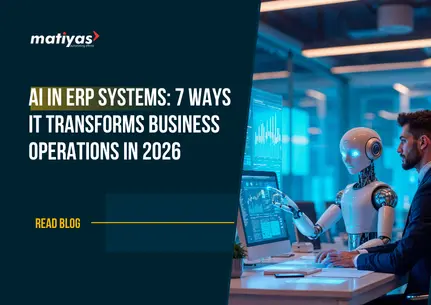
Integrating Artificial Intelligence (AI) in Enterprise Resource Planning (ERP) systems is a revolutionary development in the business world. AI in ERP is not just a futuristic concept it’s already here, making businesses smarter, more efficient, and more profitable. AI technology has significantly enhanced the capabilities of ERP systems, enabling businesses to automate complex tasks, analyze vast amounts of data in real time, and make better, data-driven decisions. This blog will explore how AI is shaping the future of ERP systems, focusing on the powerful solutions offered by Matiyas Solutions and how businesses across industries can leverage AI to thrive.
What is AI-Integrated ERP?
AI-integrated ERP refers to the embedding of machine learning, predictive analytics, natural language processing (NLP), and other AI-driven capabilities into traditional ERP systems. This enhances the ERP’s core functionalities such as finance management, supply chain operations, and customer relationship management by making them more intelligent, adaptive, and proactive.
Traditional ERP systems focus on managing data and streamlining operations. In contrast, AI in ERP systems do more than that: they learn from data over time, adapt to new patterns, and provide actionable insights that drive business success.
The Role of AI in Business Transformation
AI’s role in business transformation is significant, particularly in the context of ERP systems. By automating mundane tasks and providing deep insights into business performance, AI is redefining how businesses approach:
1. Automation and Efficiency
AI dramatically reduces the need for human intervention in routine processes, such as data entry, inventory management, and reporting. This streamlining of processes helps businesses save time and reduce errors, ultimately enhancing overall efficiency. For example, AI can automatically adjust inventory levels based on demand forecasts, reducing waste and ensuring that stock is available when needed.
2. Data-Driven Decision-Making
AI in ERP offers predictive analytics, which helps companies make better-informed decisions. AI algorithms analyze historical data, identify patterns, and generate insights that can guide decisions related to procurement, sales forecasting, and even staffing.
3. Personalization and Customer Experience
AI’s ability to analyze customer data enables businesses to offer personalised experiences. AI-driven ERP systems can predict customer behaviour and automate responses accordingly, improving customer satisfaction and loyalty.
4. Cost Reduction and Resource Optimization
By automating processes and predicting demand, AI in ERP systems helps businesses optimize their use of resources, whether personnel, inventory, or finances, leading to significant cost savings.
Key Features of AI-Integrated ERP Solutions
AI enhances ERP systems by introducing several advanced features that make businesses smarter and more efficient. Some of the most notable features include:
1. Predictive Analytics
AI-driven ERP systems can analyze vast amounts of historical data to identify trends and make accurate predictions. For example, AI can predict inventory shortages, helping businesses avoid stockouts or overstock situations.
2. Machine Learning Algorithms
These algorithms continuously learn from data, improving their predictions and automating decision-making processes. Over time, the system becomes more intelligent and efficient, able to adapt to changing business environments.
3. Natural Language Processing (NLP)
AI’s NLP capabilities allow users to interact with ERP systems using natural language, making it easier for non-technical users to navigate complex data.
The quality of these natural language interactions depends on how queries are structured. Pairing ERP NLP interfaces with an AI Prompt Generator helps non-technical users form clearer queries, which returns more useful insights from the system instead of generic data dumps
This makes AI in ERP more user-friendly and accessible to all employees, even those without technical expertise.
4. Smart Automation
AI automates routine tasks, from processing invoices to managing customer queries, freeing up employees to focus on higher-level strategic tasks. This leads to greater productivity and reduces the risk of human error.
5. Improved Customer Experience
By leveraging AI, ERP systems can predict customer demands, automate order fulfillment, and provide personalized services, enhancing customer satisfaction and loyalty.
6. Supply Chain Optimization
AI algorithms can predict supply chain disruptions and optimize routes, suppliers, and inventory levels, leading to cost savings and better resource management.
7. Real-Time Reporting and Dashboards
AI in ERP systems offers advanced reporting tools that can generate real-time insights, providing businesses with the visibility they need to stay competitive.
Benefits of AI in ERP
The benefits of AI in ERP are far-reaching and can have a profound impact on business operations across industries. Some of the primary benefits include:
1. Improved Efficiency and Productivity
AI automates repetitive tasks, reducing the burden on employees and allowing them to focus on more valuable activities. This leads to significant productivity gains and allows businesses to scale more efficiently.
2. Better Decision-Making
With AI’s advanced data processing capabilities, businesses can access actionable insights in real-time. This allows decision-makers to make well-informed, data-driven decisions quickly, ensuring that businesses can remain competitive and agile.
3. Enhanced Forecasting
AI’s predictive capabilities are particularly useful in forecasting demand, inventory levels, and even market trends. This level of foresight allows businesses to plan more effectively and reduce operational costs.
4. Cost Savings
The ability of AI to optimize processes, reduce human errors, and improve resource utilization leads to significant cost savings over time. Businesses can achieve more with less, making AI in ERP systems a powerful tool for profitability.
5. Customization and Scalability
AI-driven ERP systems are highly customizable to fit the unique needs of businesses across industries. As companies grow, their needs evolve, and AI in ERP systems scale to accommodate this growth without the need for significant system overhauls.
AI in ERP: Industry Applications
AI-driven ERP systems are applicable across industries. Some notable examples include:
Challenges of Implementing AI in ERP
While the benefits of AI in ERP are clear, implementing these systems can come with challenges. Some of the most common challenges include:
The Future of AI in ERP: Trends to Watch
The future of AI in ERP is exciting, with numerous trends and innovations on the horizon:
How Matiyas Solutions is Revolutionizing ERP with AI
Matiyas Solutions provides businesses with cutting-edge AI-based ERP solutions tailored to meet the unique needs of each industry. With a focus on automation, real-time analytics, and seamless integration, Matiyas Solutions helps businesses optimize their operations, reduce costs, and enhance decision-making.
Whether you’re in manufacturing, retail, or healthcare, Matiyas Solutions offers an AI in ERP system that can be customized to meet your business’s specific requirements. With AI capabilities that extend across financial management, inventory control, customer service, and more, Matiyas Solutions is a key partner in helping businesses unlock the full potential of AI.
Conclusion: The Future with AI in ERP
AI in ERP systems are no longer a luxury they are a necessity for businesses that want to stay ahead of the competition. With AI’s ability to automate tasks, predict trends, and improve decision-making, businesses can significantly enhance their efficiency and profitability.
Matiyas Solutions offers the tools businesses need to harness the power of AI and transform their operations. By adopting an AI ERP system, companies can future-proof their business, increase productivity, and drive sustainable growth in an increasingly complex business world.





 "I am quite happy with the ERP solution provided by Matiyas. Before we implemented their system, our organization was struggling with inefficient processes and fragmented data. Their customized ERP solution not only streamlined our workflows but also provided real-time insights into our operations. The customer support from Matiya's Team has been exceptional throughout the journey."
 "Matiyas offered us a functionally strong and automated solution to address the end-to-end needs of our business operation. This solutions will be able to scale and grow our business and it will surely reduce manual interventions."
 "I wanted to thank you Matiyas team to set-up the ERP system based on our business process. The assistance was invaluable in helping my company get as we requested. We sincerely appreciate your efforts and thanks again Matiyas team to provide us a best solution with the erp system."

 "The implementation of the Matiyas ERP solution has revolutionized our workflow. The automation of previously manual processes has not only saved us time but also significantly reduced errors. It’s like having an extra set of hands on our team, streamlining operations and boosting productivity"



 "Our company is very new to ERP, we tried to implement ERP by ourselves, however along the way we found struggles as we are very new. We are lucky HasanAli from Matiyas helped us in many ways, from a simple question to very complex developments and deployments. Rates are reasonable too! We are happy that Matiyas is there to help us."
 "The folks at Matiyas Software are the best. They're skilled, work quickly and professionally, and were able to tailor ERP to our exact specifications. Would use them again."
 "Very knowledgeable and prompt and professional. I highly recommend Matiyas for any ERP customizations."